
















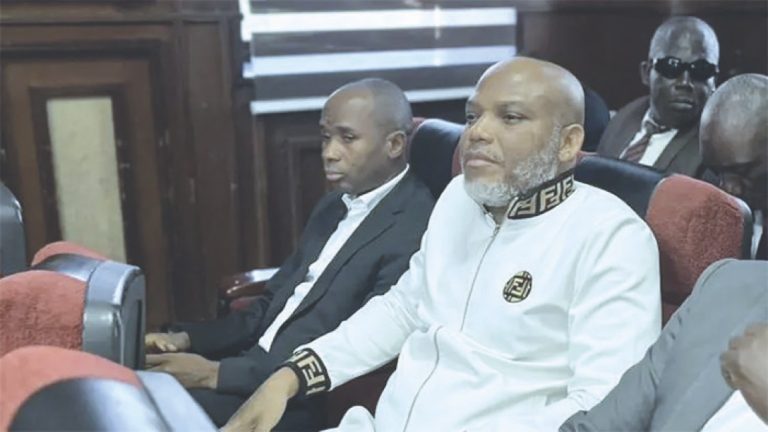
IPOB leader, Nnamdi Kanu in court during Abuja High Court ruling that sentenced him to life imprisonment, yesterday. Photo: MUDASHIRU ATANDA. After five years of theatrics surrounding his trial, the Federal High Court, Abuja, has sentenced the leader of the Indigenous People of Biafra (IPOB), Nnamdi Kanu, to life imprisonment, convicting him on all the offences contained in the seven-count terrorism charge.
Justice James Omotosho sentenced him to life imprisonment in relation to counts one, two, four, five and six of the seven-count charge in which he was prosecuted by the Department of State Services (DSS).
For count three, relating to the offences of belonging to a proscribed terrorist group, Justice Omotosho sentenced him to 20 years imprisonment without an option of fine.
On count seven, bordering on his unlawful importation of a radio transmitter for the purpose of furthering the clandestine activities of Radio Biafra, which is not registered in Nigeria, the judge sentenced him to five years imprisonment without an option of fine.
The judge, who noted that Kanu had been unruly all through the trial, said the law allowed the court to sentence him to death for the terrorism offences, but that he (the judge) as a Christian, chose to be merciful to the defendant.
Omotosho ordered that the defendant be kept in protective custody in any part of the country, but not in Kuje prison, Abuja, and that the radio transmitter be forfeited to the Federal Government.
Before pronouncing his sentence, Omotosho held that the prosecution led sufficient credible evidence to establish its case against Kanu.
The judge said the court had no option than to believe the evidence as led by the prosecution since the defendant failed to enter his defence, but chose to gamble by resting his case on that of the prosecution.
Kanu was convicted on violations of sections 1 and 2 of the Terrorism (Prohibition and Prevention) Act, 2013, which carries a death sentence.
Omotosho found him guilty of breaching the terrorism law in several broadcasts he made in which he threatened the corporate existence of Nigeria and promoted the secession of the South East region from Nigeria to form Biafra nation.
Kanu was said to have made it clear that Somalia would be a paradise unless the Biafran nation is granted.
In one of the interviews he granted Sahara Television, the convict was said that nothing would be living in a zoo called Nigeria by the time he executed his secession threat.
He also said that the only language people in the zoo (Nigeria) understand was violence and it would be given to them.
In the interview, Kanu, who claimed to be founder and director of Radio and Television of Biafra, made a broadcast to the effect that the Army of Nigeria would die. Everything called Nigeria would perish in Biafra.
At Igbo World Congress, in the United States of America, Kanu also stated on the occasion that there would be a blood boom, saying that: “America will give us guns and bullets. We are ready to perish unless they give us Biafra.”
Omotosho, in the judgment, said the allegations against Kanu were proved beyond reasonable doubt, going by an avalanche of exhibits tendered against him.
The judge held that the convict did not help matters when he bluntly refused to enter defense in the charges against him.
According to the judge, Kanu knew what he was doing while making the reckless violent statements in his numerous broadcasts.
After his judgment convicting Kanu, the prosecution counsel, Awomolo, urged the court to sentence him to the maximum punishment of death penalty.
Awomolo said more than 75 security personnel lost their lives due to the terrorism activities of Kanu, his groups and followers, while many other innocent Nigerians were also killed and public property destroyed.
He said the subjection of Kanu to the maximum punishment would serve justice to all the victims of his acts of terrorism.
“My Lord, consequent upon the conviction, nothing further remains, but the lawful imposition of sentence.
“The punishment prescribed for the offences in counts one, two, four, five and six, pursuant to Section 12H of the Terrorism Prevention Amendment Act, 2013, is death.
“With all sense of humility, I say as a prosecutor that this court has no discretion in that regard.
“The only sentence Your Lordship can impose for counts one, two, four, five and six is death, because the law empowers you to do so, and we expect that you will.”
The prosecutor also asked the court to deny Kanu access to electronic devices and to keep him in the safest custodial centre.
Meanwhile, in the absence of the convict, the lawmaker representing his constituency, Obi Aguocha, representing Okwuanu/Umuahia federal constituency at the House of Representatives, made allocutus (a plea for leniency made by a convict before his punishment), on his behalf.
He urged the court to be lenient with Kanu and to temper justice with mercy.
Earlier, there was a mild drama that saw the eviction of Nnamdi Kanu from court, as Omotosho commenced judgment in the terrorism charge against him.
The decision to proceed with the judgment in the absence of the defendant was predicated on his unruly behaviour in court.
The drama started when Kanu told Omotosho that he must not deliver judgement in the terrorism suit brought against him by the Federal Government.
Kanu’s outrage followed the dismissal of his applications, particularly the one asking for him to present a written address to the court.
Kanu had interjected during the ruling, insisting that the court could not proceed as he had not filed his final written address.
He raised his voice in court, demanding, “Which law states that you can charge me on an unwritten law? Show me. Omotosho, where is the law? Any judgment declared in this court is a complete rubbish.”
He accused Omotosho of bias and claimed that the judge lacked understanding of the law.
Omotosho, at the last sitting on the matter, waived the requirement for final written addresses, saying the court would rely solely on the arguments and materials already on record.
Kanu became livid when the judge told him that he could appeal against the decision of the court. All efforts by the judge and security operatives to make him calm down failed. He kept yelling: “You don’t know the law… Don’t touch me… God punish you.”
After a brief recess, the prosecution, led by Awomolo, urged the court to continue the trial without Kanu, citing his disruptive conduct.
Omotosho stated that, while a defendant had a constitutional right to be present during trial, repeated misconduct could allow proceedings to continue in their absence.
“If a defendant misconducts himself or acts in an unruly manner during the course of his trial, his trial can be conducted in his absence,” he said.
He added that the Court of Justice is a temple of God. He noted that Kanu’s unruly attitude was not new, as he had previously exhibited similar behaviour several times in the past.
The judge added that Kanu had indicated he would not present a defence, and that Thursday’s session was for judgment and possible sentencing.
Following the order, Kanu was removed from the courtroom, and the judge proceeded with delivering the ruling. The theatrics surrounding Kanu’s case started in 2015 when the IPOB leader was arrested and subsequently arraigned in court by the Nigerian government over allegations of terrorism and treasonable felony, defamation, managing an unlawful society and illegal possession of firearms, among other charges. After the arraignment, Kanu was granted bail on stringent conditions, but he fled the country after his residence was invaded by security operatives. In March 2018, an amended indictment was prepared against him in absentia.
In June 2021, the Nigerian government, in collaboration with its Kenyan counterpart, abducted and extradited Kanu from Kenya to Nigeria, an action that attracted widespread criticism as being in disregard of the countries’ respective local laws, international laws, conventions and treaties.
Following his re-arrest in Kenya, the indictment against him was amended on three further occasions: first on October 13, 2021, and October 20, 2021, when it expanded from four charges to seven charges; and then on January 17, 2022, when it expanded again to cover 15 charges. Kanu pleaded not guilty to all charges.
He challenged his extradition by instituting both civil and criminal proceedings in Nigeria and Kenya against the respective governments. In a 13-page judgment delivered on June 24, 2025, over one of the civil suits, Justice E.C. Mwita of the High Court in Nairobi, Kenya, declared Kanu’s extradition illegal, unlawful, unconstitutional, and, in consequence, awarded 10 million Kenyan shillings in damages to Kanu against the Kenyan government for its role in the unlawful abduction and rendition.
That decision mirrored the earlier position of the Federal High Court, Umuahia, on October 26, 2022. In that case, Justice Evelyn Anyadike held that the extradition was unconstitutional and illegal and ordered the Nigerian Government to pay N500 million damages to Kanu.
Similarly, on the criminal matter, Justice Binta Nyako of the Federal High Court, Abuja, dismissed eight of the 15 amended charges against Kano on April 8, 2022. And on October 13, 2022, the Court of Appeal dismissed the outstanding seven charges.
Oludotun Adefope-Okojie of the Court of Appeal stated inter alia: “… By the forcible abduction and the extraordinary rendition of Mr Kanu from Kenya … in violation of international laws and state laws, the lower court or indeed any court in this country is divested of jurisdiction to entertain charges against Mr. Kanu and I so hold.”
However, the Supreme Court overturned the judgment on December 15, 2023, ordering continuation of the trial. The apex court acknowledged the illegality of Kanu’s rendition, but held that such an unlawful act has not divested any court from proceeding with the trial. It maintained that: “Our law is that evidence illegally obtained is valid before the court. A violation of Mr Kanu’s right should have been by way of civil proceedings.”
The resumed hearing had a turbulent take-off and has been marred with diverse disruptions largely instigated by Kanu, the defending party. The situation deteriorated to the point that Justice Binta Nyako, who had been presiding over the trial, recused herself at the instance of the defendant. She was not the only judge who handled the case and excused herself at a point. Justice Mohammed, the first judge to preside over the initial arraignment in December 2015, recused himself.
Before Justice Nyako’s final disengagement from the case, she had earlier recused herself, only for the Chief Judge to return the file to her. Justice John Soho had sat over the case and recused himself before becoming the Chief Judge. The current judge, Omotosho, took over the case in March this year. Kanu openly accused the judges, including Omotosho, of bias and poor knowledge, which stalled the proceedings. Kanu mostly raised his objections on grounds of fair hearing and the jurisdictional competence of the court which, however, dismissed them for want of merit.
But Kanu has remained resolute. In a letter addressed to Justice Omotosho dated October 28, 2025, titled “Dismissal of prosecution of Mazi Nnamdi Kanu for lack of jurisdiction”, Kanu’s international counsel, Bruce Fein (a U.S. national), threatened that the judge would be ‘legally implicated’ in the crime allegedly committed by the Nigerian government (over the continuous detention and prosecution of his client) if he refuses to dismiss the case. The letter raised questions on the propriety and motive of a lawyer to write directly to a judge presiding over a live case.
However, when the trial eventually progressed to the defence stage, Kanu disengaged his legal team and elected to self-defend but persistently refused to file his statement of defence until the court threatened to foreclose his right to defend the suit.
The sun

