




















India’s Modi government is eyeing a passage of key bills that could overhaul Parliament seats and pave the way for a women’s quota. The opposition has reservations, casting doubt on the intentions behind the push.
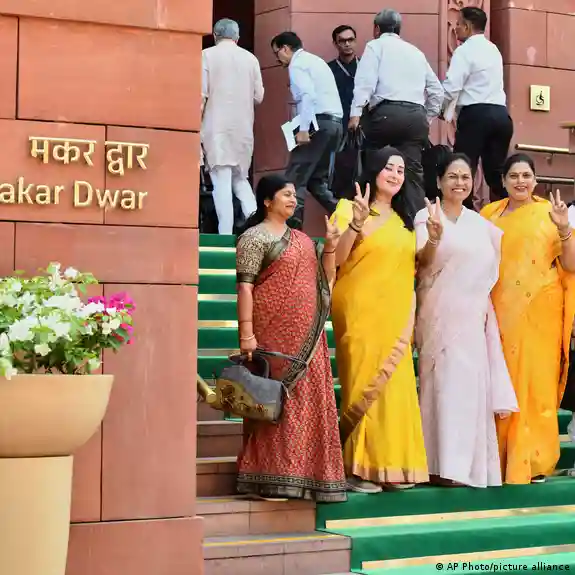
India’s parliament is set for a Friday vote on a crucial stack of three bills that could expand the size of the legislative body to increase the representation of women lawmakers.
The government of Prime Minister Narendra Modi on Thursday proposed the amendment bills in a special session of the Parliament, aimed at bringing forward the implementation of a 2023 law guaranteeing a 33% quota for women in the national Parliament and state assemblies from the 2029 general elections.
The women’s quota is tied to a separate and controversial bill to redraw voting boundaries based on population under the Delimitation Bill.
The opposition has accused Modi’s Bharatiya Janata Party (BJP)-led government of using the women’s quota issue as a ploy to secure more votes ahead of the 2029 polls. It has also questioned the government’s intentions behind linking the quota with the redrawing of voting boundaries based on census.
On Thursday, the parliament saw a marathon 12-hour debate on the bills with both Modi and the opposition taking jabs at each other.
What are the three bills being considered in the Indian Parliament?
The Constitution (One Hundred and Thirty-First Amendment) Bill, 2026 proposes increasing the number of seats in the Lok Sabha, the lower house of Parliament, from 543 to around 850, comprising 815 members from the states and 35 from the Union Territories.
The Delimitation Bill, 2026 establishes a Delimitation Commission tasked with altering seat allocations in Parliament and state assemblies based on the most recent population census — held in 2011 — and redrawing constituency boundaries accordingly. At present, the 1971 census defines the composition of the Lok Sabha. The 84th Amendment Act of 2001 froze constituency boundaries until the first census after 2026.
The Union Territories Laws (Amendment) Bill, 2026 works in tandem with the first two bills to extend the one-third quota for women to the legislative assemblies of Union Territories, including Delhi, Jammu & Kashmir, and Puducherry.
Opposition cries foul over delimitation
In essence, the women’s quota has broad cross-party support.
But opposition parties are concerned that a population-based redistribution of seats would tip the scales in favor of the BJP, which has a large support base in the densely populated northern states.
Another contention comes from India’s southern states.
The BJP found itself in the cross hairs of southern leaders who say that population-based delimitation would unfairly tilt political representation in favor of the northern states, where population growth has been higher.
They have also questioned whether the states in the south are being “punished” for better population control and economic development.
On Thursday, Congress party leader Priyanka Gandhi called for the implementation of the women’s quota law on the basis of the current 543 seats in the Lok Sabha.
Women currently account for 14% of the lower house.
What has Modi said?
Modi said in his parliamentary address on Thursday that the bills were aimed at bolstering women’s participation in governance.
“We are providing a new direction to the country. We are trying to create a positive impact. This will shape a new direction in the political sphere. I feel fortunate to be part of a moment that brings half of the population into policy-making,” he said.
“Women have not forgotten those who have stood against their rights,” he added.
The prime minister attempted to alleviate concerns over the delimitation exercise, saying the process would not do any injustice to any state or discriminate against anyone.
Indian Minister of Home Affairs Amit Shah presented numbers while giving assurances that the current proportional representation of southern states would remain largely unchanged and would not be affected by delimitation.
Tamil Nadu Chief Minister MK Stalin rejected Modi and Shah’s verbal assurances, calling the bill a “calculated deception”, adding that it would not be accepted.
Women’s Reservation Act, 2023, comes into force before vote on amendments
Even as deliberations on the amendment to the women’s quota law continue, a notification by the law ministry showed that the Women’s Reservation Act 2023 had come into force as of Thursday.
Indian media reports cited officials as saying that it was a “technical” step to operationalize the proposed amendment being debated in the Parliament.
An official told news agency PTI that bringing the law into force was essential as its proposed amendment would not have come into effect without the move.
The law is in force but its provisions cannot be implemented immediately, reports said.
The law stipulates that the reservation will take effect only after a fresh delimitation exercise is conducted based on the next census, reports added.
Congress’ Upper House Chief Whip Jairam Ramesh called the notification “absolutely bizarre”.
“The Nari Shakti Vandan Adhiniyam passed in September 2023 has come into force today while amendments to it are being debated and will be voted upon tomorrow. Completely puzzled,” he said on X referring to the Act.
When will the vote take place?
The vote is slated to begin at 4 pm (12:30 pm CET).
The constitutional amendment requires a special two-thirds majority to pass in Parliament.
The BJP-led National Democratic Alliance government does not have the two-thirds majority and will bank on smaller parties and opposition groups for their support to the bills.
Edited by: Rana Taha
DW News

