






















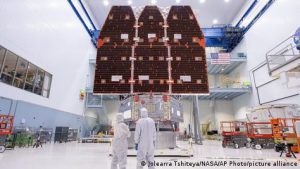
The Nancy Grace Roman Space Telescope, named after NASA’s first Chief of Astronomy, will observe black holes, exoplanets and exploding stars.

NASA has launched a powerful new telescope designed to explore distant planets, exploding stars and black holes while surveying the universe on an unprecedented scale.
The Nancy Grace Roman Space Telescope, named after one of the first women to hold a senior leadership position at NASA, was launched aboard a Falcon Heavy rocket operated by Elon Musk’s SpaceX from Cape Canaveral, Florida, on Sunday.
The telescope is expected to reach its destination, approximately 1.6 million kilometers (about one million miles) from Earth, in approximately one month’s time.
The mission has a total budget of more than $4 billion (€3.45 billion). The first images are expected back on Earth in early 2027.
What will the Roman telescope do?
Astronomers will use “Roman” to investigate a wide range of cosmic phenomena, including black holes, exoplanets and exploding stars.
“It’s going to find thousands of supernovae, tens of thousands of planets, billions of galaxies and tens of billions of stars,” said NASA science mission director Nicky Fox. “It’s going to be able to do things that we’ve never been able to do before with its massive field of view.”
Roman operates in a similar way to the Hubble Space Telescope, which was launched in 1990 and is now showing signs of age while operating with reduced capabilities.
Scientists expect Roman to generate more than 500 terabytes of data every year. By way of comparison, Hubble has collected approximately 400 terabytes of data in over three decades in space.
“Roman’s vast reach will allow us to find the weird, the rare and the unusual,” senior project scientist Julie McEnery said on Saturday. “We’ll redefine what it means to find a needle in a haystack.”
Who was Nancy Grace Roman?
The James Webb Space Telescope, named after former NASA administrator James Webb, was launched in late 2021 to complement Hubble. Webb observes the universe at different wavelengths, complementing the observations that will be made by Hubble and Roman.
Launching nearly a year ahead of schedule and within budget, Roman is NASA’s first space telescope to be named after a woman. Nancy Grace Roman served as NASA’s first Chief of Astronomy throughout the 1960s and 1970s, and retired NASA scientist Ed Weiler said the honor was long overdue.
“This is very, very fitting,” he said. “I think Nancy would be very proud.”
Edited by: Dmytro Hubenko
DW News

