






















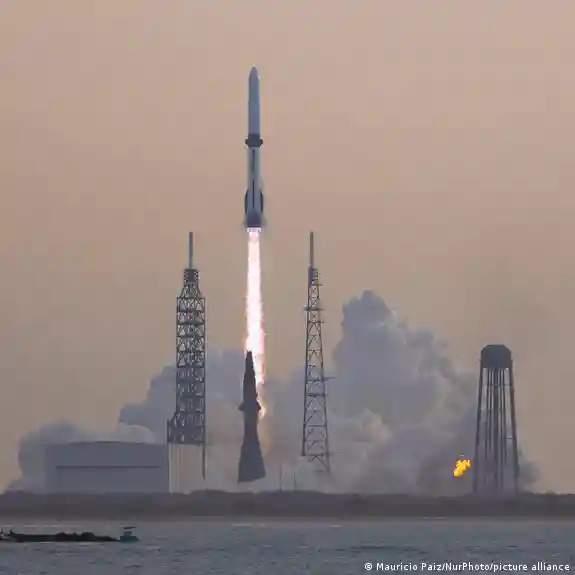
US aviation regulators have ordered Blue Origin, a space company owned by billionaire Jeff Bezos, to investigate a malfunction in the upper stage of its New Glenn rocket.
The US Federal Aviation Administration (FAA) on Monday ordered Blue Origin, the space technology company, to investigate the failure of the second stage of its massive New Glenn rocket.
Although the rocket launched successfully from Florida on Sunday, it failed to deploy the AST SpaceMobile communications satellite into the correct orbit.
The FAA is requiring Blue Origin, owned by US billionaire Jeff Bezos, to conduct a mishap investigation and obtain agency approval of its final report before resuming flights. The agency is also demanding that the company take any necessary corrective actions.
What do we know about the mishap?
On Sunday, the rocket blasted off from Cape Canaveral Space Force Station. The reusable first-stage booster performed well, landing on an ocean barge several minutes into the flight.
However, the upper stage was unable to place the satellite into a high enough orbit for it to begin operations.
According to Blue Origin CEO Dave Limp, preliminary data suggests that one of the upper-stage engines did not generate sufficient thrust.
On Monday, the US Space Force reported that the rocket’s upper stage and the satellite had reentered the atmosphere.
Competition in the space
Sunday’s mission marked only the third flight of the 29-story-tall New Glenn rocket, named after John Glenn, the first American to orbit Earth in 1962.
NASA plans to use New Glenn to launch Blue Moon lunar landers for the Artemis moon program. SpaceX’s Starship is also a contender to land astronauts on the moon by 2028.
The New Glenn 3 launch followed a series of delays this month and came after the successful NASA Artemis II mission, which sent a crew of four astronauts more than 252,000 miles from Earth, farther than any humans had traveled before.
Edited by: Louis Oelofse
DW News