













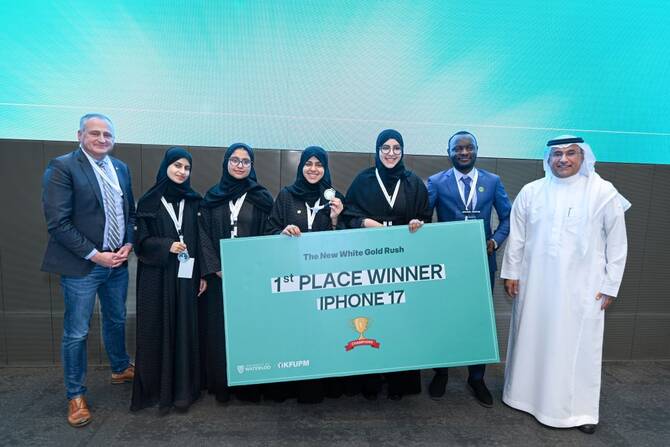
DHAHRAN: Students from the King Fahd University of Petroleum and Minerals took first place in the inaugural White Gold Rush competition here this week, beating teams from Canada’s University of Waterloo in a contest focused on natural hydrogen.
Often called the “new white gold,” hydrogen is being explored as a low-carbon alternative to oil.
The competition challenged undergraduate students from the institutions to examine how hydrogen is produced, migrates and accumulates underground, and to develop a framework for hydrogen systems modeled on the petroleum system.
Teams of three to four students presented research across six themes: source and origin, migration and accumulation, exploration and drilling, extraction and transportation, sustainability and impact, and economic feasibility.
Three judges from each university made the final call. First, third and fourth places went to KFUPM teams. Teams from Waterloo won second, fifth and sixth.
KFUPM’s winning team, HydroNova, consisted of Shahad Darwish, Ayah Alaradi, Linah Alhussain and Fatimah Alibrahim.
Prof. Khalid Al-Ramadan, who teaches geology and heads the Geosciences Department at KFUPM, oversaw the competition and spoke to Arab News about its importance.
“We are looking to empower our students at early stages of their studies of thinking about renewable energy.”
“It would be nice for our students, specifically undergraduate bachelor students, to work on something that is tangible, that is relevant to our nation, to the energy industry.”
“The Kingdom of Saudi Arabia, as well as the world, are looking now at renewable type of energy that is clean, affordable, and cheap,” he added.
Al-Ramadan said 14 KFUPM teams competed in the semifinals, with three advancing to the finals. Waterloo began with five teams as part of a credited course, with three flying to Saudi Arabia for the final round.
He said the students learned a great deal over the five-week literature review.
“And some of those ideas that’s been presented by the students really, really are marvelous and innovative, and I believe they can be tweaked and turned into a product or something that can be also served as a great idea for the industry to adopt.”
Chris Houser, dean of the Faculty of Science at the University of Waterloo and a professor in the Department of Earth and Environmental Science, flew in for the occasion.
Houser told Arab News: “Nobody (from the Canadian side) had a previous association with Saudi. Nobody knew the geology of Saudi before they got here.
“Nobody had really delved into hydrogen before that. So in those six to eight weeks, on top of courses, on top of exams, they met the challenge. They got here and presented their ideas.”
While there are no plans to fly KFUPM’s winning team to Waterloo, Houser hopes it happens. “We’re actually hoping that’s part of the conversation … They are more than welcome.”
He added: “We will make it in our summer so that they’re not dealing with two feet of snow. We’re loving it here because there’s a lot of snow at home.”
Ali Al-Yousef, dean of the College of Petroleum Engineering & Geosciences at KFUPM, highlighted the program’s broader context during the awards ceremony.
“As a part of our long-term strategy and the Vision 2030, the Kingdom is investing heavily in a clean, affordable and sustainable community source … hydrogen stands out, and it is highly relevant to our region and to the world. And within hydrogen, it takes up many forms, such as green, blue, purple.”
He noted that naturally-occurring white hydrogen has captured global attention.
Asia Maheu, whose team from Waterloo won second place, reflected on the experience.
She said: “In one of our classes, it was kind of just dropped in our lap that there’s this amazing opportunity to compete in semifinals at the University of Waterloo, and just really dig into a project that we know nothing about,
“And I was honestly just super interested in doing a course where I’m not being graded on anything — just doing research for the pure science of it all. I thought that was really, really fun,” she said.
“This is my first trip ever out of North America and I honestly just really also was enticed by the opportunity to travel to Saudi Arabia.
“I have really been blown away by the hospitality of the university, as well as every place that you visit, the hospitality has been incredible, and I really just feel so grateful to be able to be here and to meet so many new people.”
She added: “On my team, it’s myself, I’m in geology. We also have Nathalie Boal, she’s in hydrogeology, and then Katrina Hynek and Joey Ruck are both geophysics.
“So we had a couple of different specializations going into this, which I think was really nice as we were able to use our strengths to kind of hone in on the different parts of the project that we wanted to do.”
Bashaier Al-Arfaj, part of the KFUPM global engagement team, spoke about the “remarkable collaboration” between the two leading institutions.
“This is only the beginning, and we look forward to expanding this partnership and continuing to create meaningful global experiences that empower future leaders,” she said.
ARAB News

