






















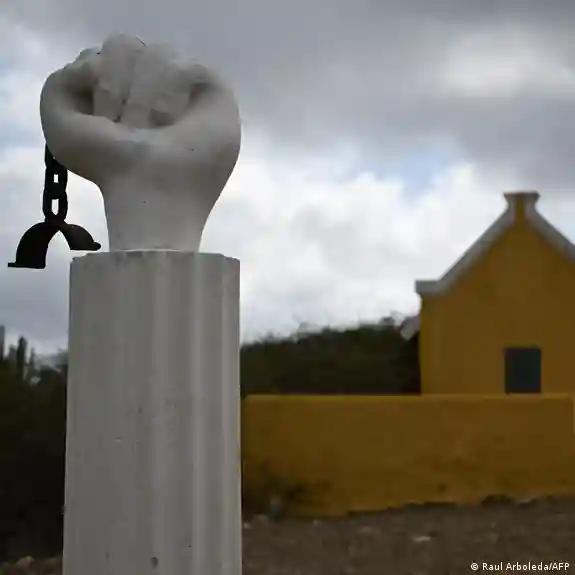
Jamaica will ask King Charles III to refer questions about the legality of slavery and Britain’s potential obligation to provide reparations.

Culture Minister Olivia Grange is leading a delegation which will ask the king, Jamaica’s head of state, to refer three questions to the Judicial Committee of the Privy Council, the island’s highest court of appeal in London.
The three questions on the legality of the transatlantic slave trade are:
Whether the enslavement of Africans in Jamaica was legal under English law
Whether it broke international law, and
Whether Britain now has a legal duty to provide redress
Jamaica says the petition would be the first time a Commonwealth country has used the legal route to pursue reparatory justice.
What did Jamaica say about reparation for slavery?
Grange pointed to Britain’s £20 million (€23.28 million) compensation payment to slave owners following the abolition of slavery in 1833.
“Up to 2015, Britain was paying the slave masters, because we were being considered property,” Grange said.
“The question really should be: if in modern times we’re still paying back the slave masters for the property that was our people, our ancestors, for property that was because of the abolition of slavery, then why shouldn’t we be pursuing some remedy at this time?”
Grange said Jamaica wanted the legal questions answered before deciding on its next steps.
The Jamaican delegation will also meet British Museum officials to discuss the return of colonial-era artefacts.

While Caribbean nations, in recent years have called for an apology and measures including debt relief, the British government has said it will not pay slavery reparations.
Transatlantic slave trade then and now
The transatlantic slave trade between the 15th and 19th centuries involved Europeans (and later Americans) kidnapping, enslaving and transporting of millions of Africans to their colonies in the Americas and the Caribbean.
An estimated 12–15 million Africans were forcibly transported across the Atlantic over four centuries, with about 10.7 million surviving the journey to the Americas. Up to 2 million died during the crossing.
Haiti gained independence from France in 1804 after a successful slave revolt, but France forced the new state in 1825 to pay 150 million gold francs to former slaveholders as compensation for “lost property,” threatening war if it refused.
It took Haiti more than a hundred years to settle the debt plunging the Caribbean into a long-term cycle of poverty.
The legacy of slavery remains a contentious issue. Earlier in March, when the United Nations General Assembly voted to recognize the enslavement of Africans during the transatlantic slave trade as “the gravest crime against humanity,” the United Kingdom and European Union member states abstained, while the United States, Israel and Argentina voted against the resolution.
Edited by: Elizabeth Schumacher
DW News

