


















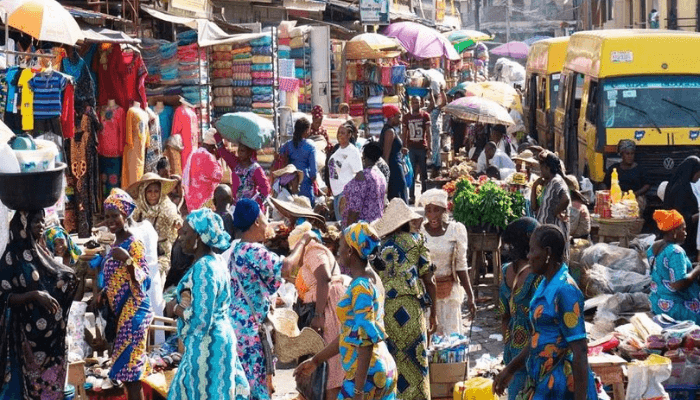
Economic experts have expressed mixed expectations over Nigeria’s economic outlook in 2026, warning that despite positive macroeconomic indicators, poverty levels may worsen, jobs remain scarce and small businesses continue to struggle under high costs, weak infrastructure and policy distortions.
Prof. Akpan Ekpo, Executive Chairman, Foundation for Economic Research and Training (FERT), explained that despite forecasts of economic growth, Nigerians should not expect any significant drop in poverty levels.According to him, small and medium enterprises (SMEs) would face another tough year due to limited access to credit, unreliable power supply and insecurity, stressing that these challenges continue to discourage productive investment.
“I think poverty will increase because the projected growth in GDP will not have any positive impact on poverty. The GDP will grow by 4.8 or 4.9 per cent. It will have no impact on poverty reduction. The GDP has to grow at least double digits, sustained for 15 years, to have any dent on poverty reduction.
“We need deliberate government policies that are implemented, not dependent on GDP growth. So, I do not see the economy for this year growing to a point it will reduce poverty.
“The exchange rate is relatively stable, at a very high rate. But the exchange rate should be less dependent on oil export. We should try and implement the policies of manufacturers so that we have a productive economy, where we produce and manufacture non-oil goods and export them to other things and are not dependent on the oil sector.
“You can see where the world is now. America has entered Venezuela and they are interested in their oil. If they have that oil and they pump it out, oil prices will drop and that will affect us,” Ekpo said.
He also pointed out that government costs are very high and real economic progress is limited, mostly benefiting elites, with little gain for the working class.On small businesses, Ekpo said SMEs face many challenges, especially lack of access to credit despite government funds. He stressed that poor power supply forces businesses to run on generators, which is unsustainable, adding that insecurity will deter foreign investment if not addressed.
He further noted that major sectors like health and education are in disarray, and expressed doubts that this year will be different, and further raised questions on official inflation figures, saying they don’t match market realities.
Similarly, Femi Saibu, a professor of Economics at the University of Lagos (UNILAG), noted that Nigeria begins 2026 with cautious optimism, supported by stable foreign exchange, increasing oil production, and ongoing economic reforms.
He cautioned that poverty could worsen, job creation may stay sluggish, and inflation risks remain due to election-year spending, weak investment in the real sector, and rising costs.
Saibu added that while small businesses might benefit somewhat from forex stability, they would continue to face challenges such as limited access to credit, high energy expenses, and regulatory hurdles.
According to him, “Nigeria enters 2026 with cautious optimism. Economic growth is projected at around 4.5 percent, buoyed by foreign exchange stability, rising oil output, and ongoing structural reforms.Inflation is expected to moderate toward 13 percent, while external reserves may strengthen to over $51 billion. Poverty is set to deepen, with nearly 141 million people, about 62 percent of the population, living below the poverty line.
“Election year dynamics could reignite inflation, while credit tightening may hurt small businesses.
“Without policy credibility and consistent implementation, the optimism of 2026 risks becoming another missed opportunity.”
On his part, Economic and Development Expert, Dr. Aliyu Ilias, said Nigeria’s macroeconomic outlook for 2026 appears positive, but questioned how much of the gains would translate into improved welfare for ordinary Nigerians.
Ilias said poverty could reduce as reform effects begin to filter through the economy, but expressed concern that job creation may remain weak due to the dominance of the service sector.
He added that inflation could ease further if transportation and energy costs are addressed, while small businesses could benefit if interest rates and energy prices are reduced.Deliberately identified suppliers or large scale producers who should be directly contacted to assist in the aggregation of these staples without necessarily applying BPP protocol or going to the open market while arranging to plough back the purchased commodities into the market targeting the vulnerable citizens first.
“Mind you at the current 14% food inflation rate any intervention in the market is already anathema to the principles of GMP but it is a necessary pill to swallow in order to calibrate prices which will make Nigeria’s food system a bit more efficient.
“Creating food banks and transparent and efficient distribution of these items will ensure accountability and probity,” he said.
He emphasized that to ensure the implementation of this programme requires the buy-in of all relevant stakeholders to make the intervention impactful otherwise the program will fail.
The sun

