

















Workers across nearly all industries have taken to the picket lines as rents soar and the housing crunch worsens. The crisis is the main political debate ahead of Spain’s November 29 elections.
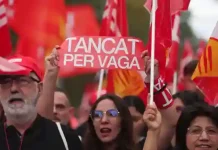
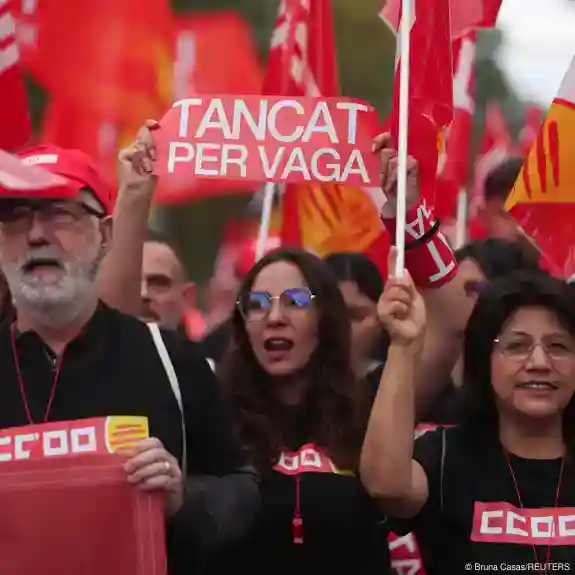
Workers across Spain gathered en mass on Wednesday, marching and setting up picket lines despite stormy weather in many areas of the country.
This is the first general strike in Spain in 14 years, amid a worsening cost of living and lack of housing crisis that has left many unable to support themselves.
Symbolized by the eviction and death of 87-year-old Maricarmen Abascal in Madrid earlier this year, the crisis has also prompted a snap election set for November 29.
The government of left-wing Prime Minister Pedro Sanchez attempted to pass legislation to ease the plight of renters, but was blocked in parliament by opposition parties. Lacking the power to get legislation passed, Sanchez called the early vote in hopes to shore up more support.
“We won’t stop until we transform this country’s housing model from top to bottom so that houses are for living instead of being at the service of the [landlord] minority,” said Alicia del Rio, spokesperson for the Madrid Tenants’ Union.
While most of the protests appeared to be proceeding peacefully, strikers in front of Madrid’s Mercamadrid wholesale market said that police had used pepper spray on the crowd, prompting at least 13 people to seek medical attention.
Some airlines later reported disruptions on flights in and out of Spain as some airport and airline workers participated in the strike.
How bad is Spain’s housing crisis?
The country has a deficit of about 750,000 homes, which is set to grow to more than a million by 2028 according to estimates from the central bank.
With fewer and fewer individuals and families able to buy a home, the number of renters in the country has risen sharply. According to Spain’s youth council, the average rent is €1,176 ($1,315). This is equivalent to 99% of the average young person’s salary.
The general strike comes a day after rail workers launched a strike over two major deadly train crashes this year, making decrepit infrastructure also a major topic in the upcoming parliamentary elections.
How have political leaders reacted to the strike?
The government has support the strike, saying it is being held “in favor of rights” rather than against anyone. Sources close to Sanchez inner circle have gone so far as to say it is “against the opposition.”
Alberto Nunez Feijoo, leader of the conservative People’s Party (PP), stated that if this is indeed “a strike against the opposition,” it is “an absurdity the likes of which does not exist in any other European Union country.”
Although the UGT labor union, one of the organizers of the strike, and Sanchez’s socialist PSOE party are two separate institutions, they do share a historic founder in Pablo Iglesias Posse.
Elizabeth Schumacher Reporter and editor with a focus on social issues in Germany
Edited by: Kieran Burke
DW News

