






















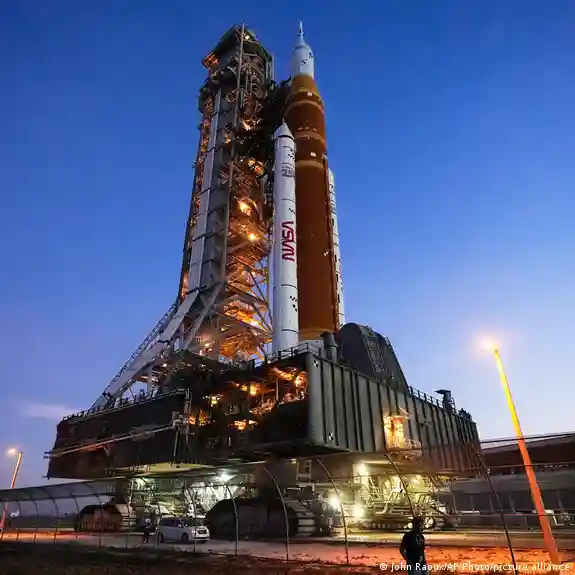
Riddled by technical delays, NASA’s Artemis II mission would mark humanity’s first trip to the moon in half a century.
The long-delayed crewed moon mission Artemis II could launch at the beginning of April, NASA officials told reporters at the Kennedy Space Center on Thursday.
“We are on track for a launch as early as April 1, and we are working toward that date,” NASA official Lori Glaze said.
The expedition would mark humanity’s first journey to its celestial neighbor in over 50 years. It is part of the US drive to land on the moon by 2028.
Nevertheless, Glaze warned that an April liftoff is not guaranteed as significant repair work and preparations remain.
“It’s a test flight, and it is not without risk, but our team and our hardware are ready,” Glaze said. “Just keep in mind we still have work” to finish.
Artemis II’s launch was previously set for February but was postponed due to technical issues during testing. In particular, a problem with the flow of helium forced engineers to reschedule the mission, following prior delays.
Now, the US space agency expects to only have a few days in early April to launch before it would need to stand down until April 30 or early May.
At 322 feet (98 meters), the rocket system must first be moved back to the launch pad at the Cape Canaveral Space Force Station in Florida. The target date for that move currently stands at March 19.

The first Artemis flew closer to the Moon — about 80 miles above the surface — but NASA said Artemis II would still be “tens of thousands of miles closer than any human has been in more than 50 years.”
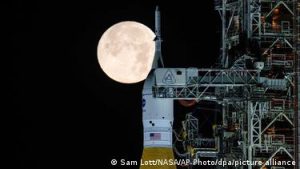
“At this distance the moon will appear to the crew to be about the size of a basketball held at arm’s length,” the space agency said.
Four astronauts are set to be on board the spacecraft to fly around the moon: US astronauts Christina Koch, Victor Glover, and Reid Wiseman, as well as Canadian Jeremy Hansen.
Edited by: Sean Sinico
DW News

