



















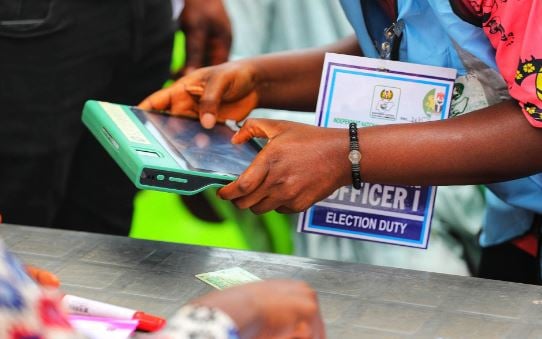
The Senate on Tuesday bowed to intense public pressure and approved the electronic transmission of election results to the Independent National Electoral Commission’s Result Viewing Portal, IReV, while permitting manual collation to serve as a backup where technology fails.
The decision followed an emergency reconsideration of a disputed clause in the Electoral Act (Repeal and Re-enactment) Amendment Bill, 2026, after days of nationwide outrage, street protests, and sustained criticism from opposition figures, civil society organisations and youth movements.
However, the Upper Chamber stopped short of making electronic transmission compulsory and rejected calls for the explicit inclusion of real-time upload of results, a key demand by protesters who accused lawmakers of attempting to weaken electoral safeguards ahead of the 2027 general elections.
Under the reviewed provision, presiding officers at polling units are required to electronically transmit results to the IReV portal after voting and documentation have been completed.
The amendment, however, provides that where electronic transmission cannot be carried out due to communication or network challenges, the manual result sheet, Form EC8A, shall become the primary basis for collation and declaration.
While putting the motion to a voice vote, Senate President Godswill Akpabio urged senators who opposed the amendment to formally challenge it on the floor.
“It’s very simple. If you disagree with him, move your counter motion. So, if you agree with him, you agree with me when I put the votes,” Akpabio said.
He explained that the motion before the chamber sought to reverse an earlier Senate decision on Section 60, Subsection 3 of the Electoral Act, which had triggered public backlash.
“When I ask for the votes, when I ask for your consent, let me read the motion. His earlier motion, which passed in our last sitting, he has sought to rescind that. That is in respect of Section 60, Subsection 3. And this is what he said,” Akpabio stated.
Reading the amended clause, the Senate President said, “That the presiding officer shall electronically transmit the results from each polling unit to the IReV portal.
“And such transmission shall be done after the prescribed Form EC8A has been signed and stamped by the presiding officer and/or countersigned by the candidates or polling agents, where available at the polling units, because sometimes you don’t see any polling agent.”
Akpabio added that the law now accommodates situations where electronic transmission becomes impossible.
“Provided that if the electronic transmission of the results fails as a result of communication failure — in other words, maybe network or otherwise — and it becomes impossible to transmit the results electronically in Form EC8A signed and stamped by the presiding officer and/or countersigned by the candidates or polling agents where available at the polling units, the Form EC8A shall in such a case be the primary source of collation and declaration of results,” he said.
Despite the Senate’s clarification, the amendment has continued to raise concerns among opposition parties and civil society groups, who argue that allowing manual results to override electronically transmitted ones could weaken transparency and reopen the door to manipulation, particularly in areas with poor network coverage.
Dramatic reversal
The emergency plenary followed chaotic scenes in the Senate chamber earlier, after the Senate Chief Whip, Senator Tahir Monguno (APC, Borno North), raised a point of order seeking the rescission of the chamber’s earlier approval of Clause 60(3) of the bill.
Monguno anchored his motion on Orders 1(b) and 52(6) of the Senate Standing Orders, 2023 (as amended), and was seconded by Senator Abdul Ningi (PDP, Bauchi Central).
The move immediately sparked tension, with several senators raising points of order and shouting across the aisle.
Trouble escalated when Monguno read the revised Clause 60(3) without the phrase “real-time,” replacing the word “transmission” with “transfer.”
Senator Enyinnaya Abaribe (APGA, Abia South) objected strongly, repeatedly raising points of order as the chamber descended into uproar.
According to page 45 of the report of the Senate Committee on Electoral Matters, Clause 60(3) states: “The Presiding Officer shall electronically transmit the results from each polling unit to IREV portal in real time and such transmission shall be done after the prescribed Form EC8A has been signed and stamped by the Presiding Officer and/or countersigned by the candidates or polling agents available at the polling unit.”
At the height of the disagreement, Abaribe invoked Order 72 of the Standing Orders, calling for a formal division of the chamber.
Senate appoints committee
Amid mounting pressure, the Senate also appointed a 12-member conference committee to harmonise differences between its version of the Electoral Amendment Bill and that passed by the House of Representatives.
Akpabio announced the names during the emergency plenary.
The committee is chaired by Senator Simon Lalong, with Senator Orji Uzor Kalu, Senator Tahir Monguno, Senator Adamu Aliero, Senator Abba Moro, Senator Asuquo Ekpenyong, Senator Aminu Iya Abbas, Senator Tokunbo Abiru, Senator Niyi Adegbonmire (SAN), Senator Jibrin Isah, Senator Ipalibo Banigo and Senator Onyekachi Nwebonyi as members.
Akpabio said, “After consultation with the leadership, we have moved the number from nine to 12. I will now read out the names of the conference committee members from the Senate.
“When you meet, you should recognise that this is a matter of urgency. I believe that if you are able to conclude within the next few days or one week, the President should be able to sign the amended Electoral Bill into law within the month of February.”
He added that the harmonised bill would be transmitted to President Bola Tinubu for assent before the end of the month.
Reacting to the development, Senator Orji Uzor Kalu, representing Abia North, defended the Senate’s position, describing it as a balanced approach.
In a statement shared on his Facebook page, Kalu said, “Today (Tuesday) at emergency plenary, I supported and added my voice to the Senate’s new position approving the electronic transmission of election results from polling units across Nigeria.”
He said the amendment makes electronic transmission the primary method when technology is available.
“This means electronic transmission becomes the primary method where the technology is available and functional.
“However, where it fails or becomes impossible, the duly signed Form EC8A remains the valid and primary source of results,” he added.
Kalu said the approach ensures inclusivity for communities with network challenges.
“This balanced approach strengthens transparency, fairness, and credibility in our electoral process, while ensuring that voters in network-challenged communities are not disenfranchised.
“Our democracy must work for every Nigerian, everywhere,” he said.
However, Senator Natasha Akpoti-Uduaghan (PDP, Kogi Central) publicly dissented, backing calls for the retention of real-time electronic transmission.
In a Facebook post ahead of the decisive sitting, she said Nigerians deserved elections that inspire trust.
“As I step into the Senate chamber today, I carry with me the hopes and expectations of millions of Nigerians who yearn for stronger democratic safeguards enshrined in our laws,” she wrote.
“Real-time electronic transmission of election results is a critical step toward deepening transparency, preserving the sanctity of the people’s mandate, and restoring public confidence in our electoral process.
“Our democracy must continue to evolve with systems that ensure every vote truly counts and every voice is faithfully represented.
“Nigeria deserves elections that inspire trust, strengthen unity, and reflect the genuine will of the people.”
Her intervention followed mass protests at the National Assembly Complex, where demonstrators under the banner Occupy the National Assembly accused lawmakers of rolling back reforms ahead of 2027.
Atiku, Amaechi, El-Rufai
Former Vice President Atiku Abubakar also slammed the Senate over the manual transmission clause.
At a press briefing in Minna, Niger State, following a closed-door meeting with former Military President General Ibrahim Babangida, Atiku said the current mixture of electronic and manual transmission could create challenges for voters and electoral officials.
“The expectations of Nigerians, Nigerians who are expecting real-time electronic transfer to the various levels of the elections, but what we got is a mixture of electronic and manual transmission, which is going to cause more confusion or chaos than if we had a single-tier, you know, electoral transmission system, which is real-time electronic.
“That would be our preference. And I think there is a need for all the opposition political parties to come together to pursue this issue,” he said.
He described the Senate’s recent adoption of the amended Clause 60(3) of the Electoral Act—which allows electronic transmission of results while keeping manual collation as a backup—as a compromise that falls short of full transparency.
“I mean, we shouldn’t allow it to rest where they wanted it to rest today. Absolutely not. I don’t support that,” he added.
Former Rivers State Governor Rotimi Amaechi joined protesters at the National Assembly, warning that real-time transmission could save lives.
Amaechi joined protesters on Tuesday at the National Assembly Complex in Abuja, demanding that the proposed amendment to the Electoral Act explicitly require the Independent National Electoral Commission to transmit results electronically in real time from polling units.
“The advantage is that very few people will die on the election field, very few Nigerians. You are saving the lives of Nigerians,” Amaechi told the crowd, warning that every election season sees citizens killed in large numbers while officials shield themselves behind security forces.
“What we are asking for is simple — real-time, mandatory electronic transmission of results, no more, no less,” Onyema said.
As pressure mounts, attention has shifted to the conference committee and President Bola Tinubu’s eventual assent.
With the 2027 general elections approaching, analysts say the final outcome of the Electoral Act amendment may shape not only the credibility of future polls but also public trust in Nigeria’s democratic institutions.
The punch

