



















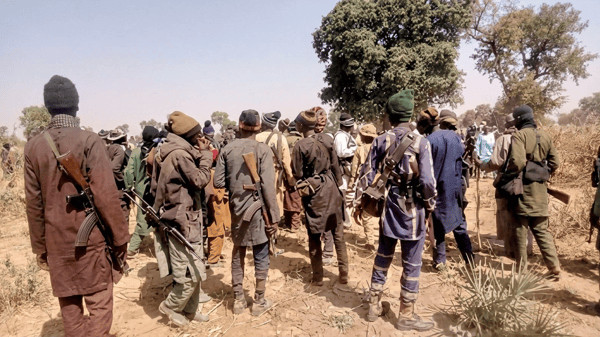
The suspected bandits are said to be keeping the victims as human shields.
A credible security source told LEADERSHIP Friday, on condition of anonymity, that in order to avoid collateral damage, it would be difficult for security agents to strike the bandits’ camp.
The source, who has been following the rescue operations since the incident last Sunday, stated that surveillance images have revealed the exact location of the bandits.
“I can’t say much about the ongoing rescue operations due to the sensitive nature of the issue. I can tell you that the security operatives have identified the location where the abducted worshippers are being kept. They are using the victims as human shields, and it will not be right for security operatives to attack the bandits together with the innocent abducted worshippers,” he said.
Meanwhile, bandits have opened communication for possible negotiations to release the kidnapped worshippers.
A prominent religious leader, who did not want his name mentioned, told our correspondent on the telephone that discussions are ongoing.
“The only thing some of us want is the safe release of those abducted. We don’t want to be discussing this issue in the media, but what I can tell you is that discussions are ongoing for the possible release of the victims,” he said.
LEADERSHIP Friday recalls that the police had deployed choppers for aerial surveillance, as well as armoured personnel carriers, in different locations in the area for search and rescue operations.
Kaduna State Governor, Uba Sani, who visited the Kurmin Wali community on Wednesday to commiserate with the people, vowed that the victims would be rescued within a few days.
Kaduna State Police Command spokesperson, DSP Mansir Hassan, did not respond to calls when contacted for an update.
However, the apex northern socio-cultural organisation, the Arewa Consultative Forum (ACF), has declared that granting amnesty to bandits, as was done for former Niger Delta militants, will not end insecurity in the region.
Reacting to the mass abduction of Kurmin Wali worshippers, ACF National Publicity Secretary, Prof. T. A. Muhammad-Baba, told our correspondent that bandits and other criminal gangs operating in the North have no central leadership.
Calling for more resources to be channelled towards containing the security crisis, the ACF said that even if it meant the government stopping certain projects, “until we end this insecurity, we must do it.”
“Well, the factors are not the same. This idea of the Niger Delta solution being applied to the North, to me, is an exaggerated narrative. It is a false narrative. The factors responsible for criminality in the Niger Delta and those responsible for criminality in Northern Nigeria are different.
“The Niger Delta has one major factor, which is oil exploration and its impact. You can understand that the factor is direct: what do these people want? Resource control and increased allocation.”
According to him, “The late President Umaru Yar’adua granted amnesty, and he did so to his credit. Now, who are you going to negotiate with in the North? Study after study has shown that this criminality is carried out not by a central organisation, but by gangs that live by their own rules. There is no central leadership; there is no central coordinating authority.
“Everyone takes up a gun and then becomes a bandit. So if you are going to negotiate, who are you going to negotiate with? It is not as if it is organised crime controlled by a single central authority. In my opinion, these are disparate groups taking up arms against the state. Now, what is the grievance? What do they want?
“So you see, the factors are many, and the simple solution of amnesty has not worked. It has been tried. A number of states in the North-West have tried to negotiate, but to what effect?”
According to him, there is no single solution to address the crisis.
“Someone takes up arms against the state and against rural people; what is the grievance? It is not something I can tell you directly and say, ‘this is the answer, this is the solution you need.’”
The ACF spokesperson further stated: “There is climate change, population growth, absence of government, and corruption. Too many people are making money out of it. Insecurity in the North-West and the North-East, and even the North-Central, has become organic. So many people are involved in it.
“The person who goes into the bush to repair motorcycles is part of the insurgency. The people who supply food, water, fuel and all kinds of logistics are involved. The government has to take control. Even if you are to negotiate, do so from a position of strength, not weakness, and ensure central coordination.
“One state will negotiate, another state will do so differently, and so on. We keep running from one part of the polity to another. I cannot give you a direct answer. We need to sit down and interrogate all the factors. The solution is for the government to take over, assert itself, and recruit, train and deploy security forces everywhere. Even if it means stopping certain projects until we end this insecurity, we must do it. The government needs to control the flow of arms.”
He advised that government must engage neighbouring countries, noting that unilateral actions by states would be ineffective.
“The same problem we are suffering is affecting everyone. When it rains in the middle of the night, you wake up in the morning and find that rain has fallen everywhere. The suffering communities are contagious, and so are the criminals.
“They are mobile. We need to change the whole security approach. There are constitutional issues. States on their own are extremely limited in what they can do because, under the Constitution, security is primarily the responsibility of the Federal Government. But the challenge is overwhelming. This insecurity has become dynamic, and the solution must also be dynamic. We need to involve the communities. They should be trained for early warning and early response so that communities begin to take responsibility for their own security.
“They will be trained to identify the factors. Someone has to be on the ground. I am going round in circles because, as I said, this problem is multifarious in terms of causation and factors,” he said.
Leadership news

