


















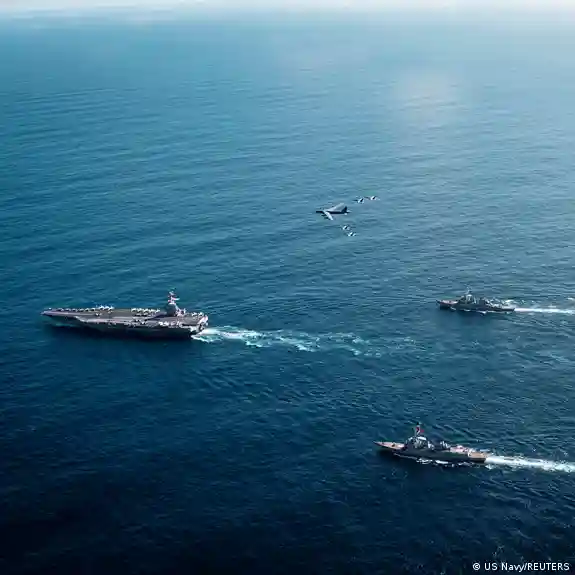
The USS Gerald R. Ford will join another US carrier group already in the Arabian Sea as Washington continues to apply pressure on the Iranian regime over its nuclear program.
The US is preparing to send the USS Gerald R. Ford’s aircraft carrier strike group to the Middle East, joining the USS Abraham Lincoln and its guided-missile destroyers in the Arabian Sea, President Donald Trump confirmed on Friday.
“It’ll be leaving very soon,” Trump told reporters without giving an exact timeline.
The deployment of a second aircraft carrier strike group to the region comes after Trump warned of “very bad” consequences if Iran did not make a deal with Washington over its nuclear program.
The Ford’s strike group is being redirected from the Caribbean, where it was deployed in October 2025 as the US built up a massive military presence in the region ahead of a raid that captured Venezuelan dictator Nicolas Maduro.
The Ford left port in June 2025, and its deployment has already been extended once. Its sailors had expected to return home in March, according to the New York Times, which first reported the re-deployment earlier Friday.
Trump hopes for ‘deal’ with Iran on nukes
The second carrier group deployment in the Arabian Sea comes after US and Iranian representatives met last week in Oman for inconclusive talks on Tehran’s nuclear program.
Trump has not ruled out military action if Tehran does not agree to curb its nuclear program.
Asked why a second aircraft carrier was headed to the Middle East, Trump said on Friday, “In case we don’t make a deal, we’ll need it… if we need it, we’ll have it ready.”
Trump during his first term in 2018 pulled the US out of a deal that had envisioned a cap on Iran’s uranium enrichment in exchange for sanctions relief.
Tehran claims its nuclear ambitions are peaceful, however, the IAEA estimated last year that Iran has enriched uranium far beyond the level needed for civilian use.
Iran suspended cooperation with the IAEA after the US bombed Iranian nuclear sites last June during a Israel’s 12-day war against the Islamic republic. At the time, Trump said the strikes had “completely and totally obliterated” Iran’s key nuclear enrichment facilities, although this was never independently confirmed.
Despite claiming that Iran’s uranium enrichment capability was destroyed, Trump has said he wants a new nuclear deal with Iran.
A White House fact sheet dated February 8 coming after tariffs on countries that “acquire any goods or services from Iran” said that Trump “recently deployed a massive armada to the region, urging Iran to come to the table and negotiate a fair, equitable deal with no nuclear weapons, or face even stronger consequences.”
Trump warns Iran
Gulf Arab nations have warned any US attack on Iran could spiral into another regional conflict.
On Friday, Trump told reporters it would be a “bad day for Iran” if Tehran fails to make a deal.
When asked on Thursday about a timeline for a possible deal with Iran, Trump said “I guess over the next month.”
“It should happen quickly. They should agree very quickly … otherwise it’s going to be very traumatic. I don’t want that to happen, but we have to make a deal,” Trump told reporters.
Trump last threatened the use of force against Iran during the regime’s deadly crackdown on anti-government protests in January, but pulled back after claiming the regime had agreed to not execute arrested protesters
Despite these claims, human rights groups estimate thousands of demonstrators were killed by security forces during the protests. In the coming days, Iranians are beginning to hold 40-day mourning ceremonies for those killed.
Edited by: Louis Oelofse
DW News

