










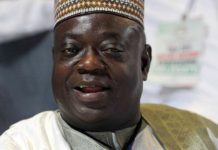





Thailand’s parliament has elected Anutin Charnvirakul to be the country’s prime minister. Analysts see the nationalist’s selection as an opportunity to restore political stability in the southeast Asian nation.

Thailand’s parliament on Thursday elected Anutin Charnvirakul to be the country’s new prime minister.
Anutin received 293 of 498 votes in the Thursday tally, easily surpassing the 249 required to win a simple majority.
He is expected to take office within days, but must first be formally appointed by King Maha Vajiralongkorn. A new Cabinet is to be assembled over the coming weeks.
Anutin, a sage political operator, deftly positioned his party between larger rival elites battling for control of the nation — first, bringing down the former government by withdrawing from the ruling coalition, and then winning the ensuing February general election.
Anutin’s Bhumjaithai party decisively won the February vote on a nationalist, pro-military, pro-monarchy platform — with political instability and the growing border conflict with Cambodia fueling the party’s strong performance.
Anutin says ‘government coalition is ready to perform’ as Thailand faces headwinds
The Bhumjaithai party is currently aligned with the politically battered Pheu Thai party — which had been in power until Anutin triggered its collapse. Anutin has subsequently assembled an unlikely collection of small parties to form an alliance that will control 292 of the current 499 seats in parliament.
Speaking on Thursday, the 59-year-old said, “The government coalition is ready to perform its duty in the legislature and executive smoothly to bring prosperity to the country. We’ll quickly form a Cabinet and give a policy statement to solve the problems of the country.”
Thailand’s reformist People’s Party will now lead the opposition, though nearly a dozen of its top members could face political bans over their attempts to overhaul the southeast Asian nation’s royal insult laws.
Can Anutin’s appointment bring long-sought political stability to Thailand?
Observers will now be looking to see if Anutin’s election will finally provide some stability to the country’s political system.
Napon Jatusripitak, a political scientist at Singapore’s ISEAS–Yusof Ishak Institute, said Bhumjaithai’s sway over both chambers of parliament as well as institutional support for Anutin raise the prospect of medium-term stability.
“People have strong reasons to believe that this government can last,” said Jatusripitak, pointing to Bhumjaithai’s current position and the fact that the nation’s opposition is “highly fragmented.”
Anutin will now be confronted with a number of pressing issues, primary among them the ongoing conflict with Cambodia, but more importantly, Thailand’s sputtering economy.
Added to existing problems, Thailand, too, faces the daunting prospect of having to manage fallout from the widening US, Israel, Iran conflict in the Middle East.
Another major hurdle that remains is the simmering border dispute between Thailand and Cambodia, which flared in December.
Although a ceasefire remains in place, the two nations have yet to resolve outstanding disputes over their 800-kilometer (500-mile) shared border.
Bhumjaithai has promised to build a new border wall, close crossings and recruit some 100,000 volunteer soldiers to beef up security.
During Anutin’s first stint as prime minister in the previous government he quickly authorized Thailand’s armed forces to take whatever actions were deemed necessary to maintain control of the border.
Edited by: Kieran Burke
DW News

