


















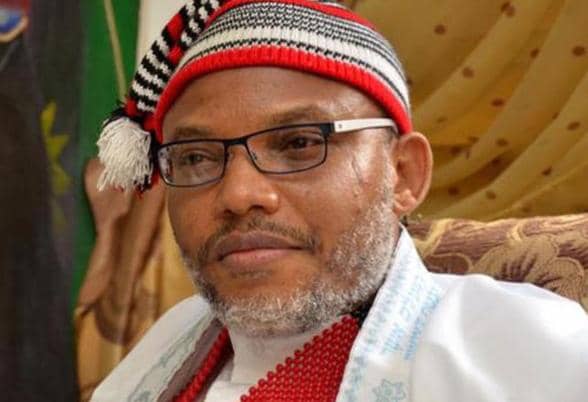
The detained leader of the Indigenous People of Biafra, Nnamdi Kanu, will today know his fate in the prolonged legal battle with the Federal Government.
A court, presided over by Justice James Omotosho of the Federal High Court in Abuja, is expected to rule on a series of applications filed by both Kanu and the Federal Government, including a request by the IPOB leader challenging the competence of the charges against him and seeking his release on the grounds of alleged unlawful detention and infringement of his fundamental rights.
Kanu has been in the custody of the Department of State Services since June 2021, following his controversial interception and return to Nigeria from Kenya in circumstances his lawyers describe as “extraordinary rendition”.
He is facing seven terrorism-related charges bordering on alleged incitement, running an unlawful group, and acts threatening national security—allegations he vehemently denies.
Justice Omotosho, on November 7, fixed Thursday to deliver judgment in the charges brought against Kanu.
Justice Omotosho announced the date while ruling on the matter after Kanu failed to open his defence, having exhausted the six days allocated to him by the court to present his defence.
While Kanu failed to open his defence after the prosecution closed its case, the IPOB leader filed a fresh motion challenging his trial.
He stated that the earlier Terrorism Prevention and Prohibition Act had been repealed, and as such, there are no valid charges against him.
He asked the court to expunge from its record “the purported plea of not guilty entered by him,” claiming it was based on deception and in defiance of the Supreme Court’s decision. He also sought an order setting aside all subsequent proceedings, arguing that they were founded on a nullity.
Kanu further asked the court to hold that the charges disclosed no offence known to law, as they were allegedly based on a repealed terrorism law. He requested an order striking out the charge for want of jurisdiction and directing his release.
He urged the court to dismiss the charges and allow him to go home.
However, Justice Omotosho had held that since Kanu failed to utilise the opportunity granted to him to conduct his defence, he could not claim to have been denied his constitutionally guaranteed right to a fair hearing.
Justice Omotosho reiterated the court’s position that no ruling or preliminary objection would be determined at this stage.
He noted that the case was filed in 2015 but suffered delays before being re-assigned to his court earlier this year, where it received an accelerated hearing.
He stated that the prosecution called five witnesses and tendered several exhibits before closing its case on June 19, 2025. The judge observed that multiple adjournments were granted at the instance of the defendant, who sought to cross-examine prosecution witnesses.
He recalled that Kanu’s no-case submission was earlier overruled, and the defendant was directed to open his defence.
Omotosho emphasised that the court had ensured a fair hearing, but noted that Kanu, despite initially agreeing to enter his defence, abandoned it and began claiming that there was no existing law under which he was being tried.
He said the defendant had not demonstrated seriousness in the proceedings, adding that he had personally appealed to Kanu “in God’s name” to present his defence and engage counsel.
Citing Supreme Court authorities, Omotosho held that if a defendant fails to utilise the opportunity of a fair hearing, the court cannot compel him to enter his defence.
The judge ruled that it was on this basis that Kanu had waived his right to defence and proceeded to fix a date for judgment.
Kanu’s legal journey has been marked by numerous adjournments, court orders, appeals, and counter-applications. The judge observed that multiple adjournments were granted at the instance of the defendant, who sought to cross-examine prosecution witnesses.
He recalled that Kanu’s no-case submission was earlier overruled, and the defendant was directed to open his defence.
Omotosho emphasised that the court had ensured a fair hearing, but noted that Kanu, despite initially agreeing to enter his defence, abandoned it and began claiming that there was no existing law under which he was being tried.
He said the defendant had not demonstrated seriousness in the proceedings, adding that he had personally appealed to Kanu “in God’s name” to present his defence and engage counsel.
Citing Supreme Court authorities, Omotosho held that if a defendant fails to utilise the opportunity of a fair hearing, the court cannot compel him to enter his defence.
The judge ruled that it was on this basis that Kanu had waived his right to defence and proceeded to fix a date for judgment.
Kanu’s legal journey has been marked by numerous adjournments, court orders, appeals, and counter-applications. Kanu alleges that the witnesses—identified in court as TAA (PW1) and BBB (PW2)—gave “false evidence on oath.”
The filing cites Sections 156, 158(1), 159(1), and 160 of the Penal Code, Section 88 of the Administration of Criminal Justice Act 2015, and Sections 34 and 36 of the 1999 Constitution (as amended).
The complaint reads partly, “On diverse dates between May and July 2025, at the Federal High Court, Abuja, during the hearing and trial-within-trial in the case of Federal Republic of Nigeria v. Nnamdi Kanu (FHC/ABJ/CR/383/2015), Mr TAA and Mr BBB, being witnesses called by the prosecution in my trial, wilfully gave false evidence on oath, knowing same to be false and/or not believing same to be true and material to the admissibility of the 2015 and 2021 statements, thereby committing perjury contrary to Sections 156, 158 and 159 of the Penal Code.”
Kanu alleged that TAA falsely denied knowing Mr Brown Ekwoaba, the Assistant Director (Investigations) at the DSS National Headquarters, who, according to him, supervised his October–November 2015 interviews and detention. The complaint referenced page 352 of the Certified True Copy of proceedings of June 26, 2025, where TAA reportedly stated: “I cannot recall… I didn’t know any other Mr Brown, my Lord.”
The IPOB leader said the denial was untrue, citing an affidavit by Prince Emmanuel Kanu confirming six visits to the DSS office where Ekwoaba allegedly conducted interviews; another affidavit by Benjamin Madubugwu confirming similar interactions; and public records showing Ekwoaba served as Assistant Director (Investigations) from 2015 to 2020 before becoming a State Director.
Kanu further accused BBB of false testimony, noting that although he claimed (on page 202 of the CTC of proceedings) to have never met Kanu except in court, he had previously testified (pages 184–188) that he led Kanu’s video interview at the DSS Headquarters on July 17, 2021.
He added that the two witnesses, who appeared masked and behind screens by order of the trial court, gave “materially false” testimony to obscure the true chain of custody of his 2015 and 2021 statements.
The punch

