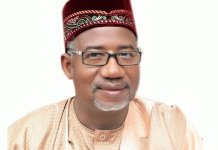











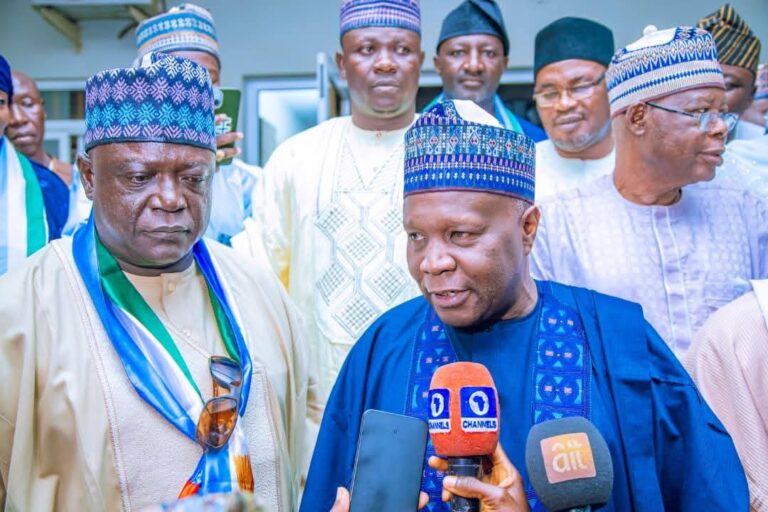
Gombe State Governor Muhammad Inuwa Yahaya has stated that President Bola Ahmed Tinubu’s decision to remove fuel subsidy was not a matter of choice but a fiscal necessity handed down by the previous administration of Muhammadu Buhari.
Speaking in Gombe during a courtesy visit by defecting politicians, Governor Yahaya disclosed that the removal of the subsidy was inevitable as the 2023 budget only made provision for subsidy payments until June, shortly after Tinubu assumed office.
According to him, the Buhari administration, aware of the unsustainable burden of subsidy payments, deliberately left the matter for the incoming government. “He was sworn in on the 29th of May 2023. What was provided in the budget that could sustain the subsidy was only up to June,” Yahaya said.
The governor disclosed that he was part of the National Economic Council (NEC) under Buhari, and that an ad-hoc committee chaired by former Kaduna State Governor, Nasir El-Rufai, had examined the issue in 2022. He explained that while the committee acknowledged the risks of immediate removal, it was eventually agreed that the final decision would be left for the administration taking office in 2023.
Governor Yahaya added that Nigeria’s financial credibility had deteriorated to the point where local and international lenders were unwilling to finance subsidy payments. He further disclosed that an $800 million World Bank facility intended to cushion the impact was not approved by the National Assembly, as Buhari’s tenure was ending.
“You could recall that the World Bank provided $800 million in support to cushion the effect. But then the people and the National Assembly said no. Buhari was close to going, and there was no point for that facility to be allowed,” he said.
He maintained that Tinubu acted in line with the fiscal reality he met on assumption of office, describing the move as one that could not be postponed further. He argued that extending the subsidy beyond June 2023 would have required fresh legislative approval, which, in his words, was not feasible.
While defending Tinubu’s action, Yahaya acknowledged the economic hardship faced by Nigerians following the removal, which led to a sharp rise in transport costs, food prices, and inflationary pressures. He, however, expressed optimism that the economy is beginning to stabilise. “The economy is stabilising and we’ve turned the corner,” the governor said.
Governor Yahaya’s remarks add to the ongoing debate over subsidy removal, which has remained one of the most controversial policy decisions in recent Nigerian history. Critics argue that the measure has worsened living conditions for millions, while government officials insist it was a necessary step to prevent fiscal collapse.
The fuel subsidy regime, introduced decades ago to make petrol affordable, had long been criticised for being riddled with corruption and draining government resources. By 2022, subsidy payments reportedly cost the country trillions of naira annually, prompting calls from international institutions and economists for their removal.
Governor Yahaya’s disclosure provides context to the policy shift, framing it as an inherited obligation rather than a discretionary choice by the Tinubu administration. However, for many Nigerians, the immediate concern remains the rising cost of living and inflation, while also questioning why the country’s debt stock keeps rising despite the savings expected from subsidy removal, yet with the burden of the reforms not translating into visible relief in their daily lives.
Daily post

