





















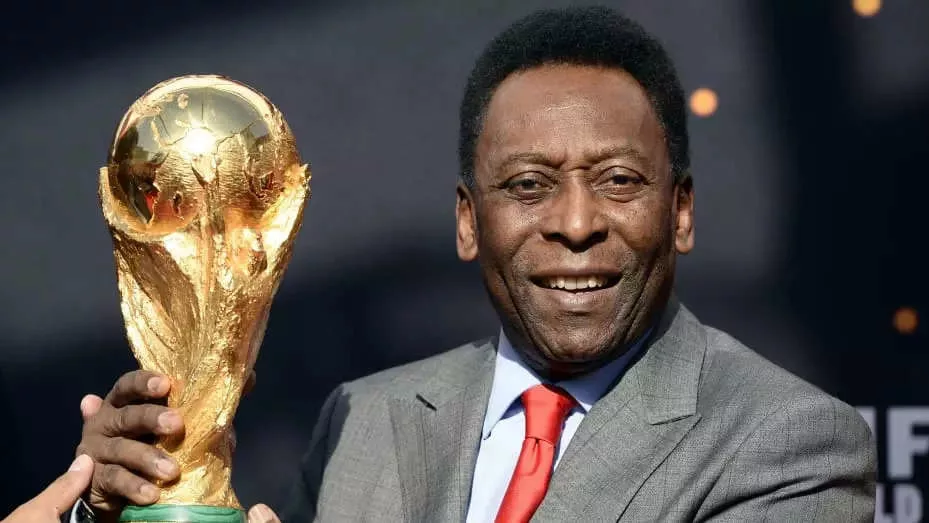
Pele, the magical Brazilian soccer star who rose from barefoot poverty to become one of the greatest and best-known footballers in modern history, died at the age of 82, his daughter said on Instagram on Thursday.
The standard-bearer of “the beautiful game’’ had undergone treatment for colon cancer since 2021 and he had been hospitalized for the past month with multiple ailments.
Widely regarded as one of football’s greatest players, Pele spent nearly two decades enchanting fans and dazzling opponents as the game’s most prolific scorer with Brazilian club Santos and the Brazil national team.
His grace, athleticism and mesmerizing moves transfixed players and fans. He orchestrated a fast, fluid style that revolutionized the sport — a samba-like flair that personified his country’s elegance on the field.
He carried Brazil to football’s heights and became a global ambassador for his sport in a journey that began on the streets of Sao Paulo state, where he would kick a sock stuffed with newspapers or rags.
In the conversation about football’s greatest players, only the late Diego Maradona, Lionel Messi and Cristiano Ronaldo are mentioned alongside Pele.
The Brazilian Football Federation posted a picture of Pele celebrating a goal, saying “RIP Pele” and adding three crown emojis.
Sir Geoff Hurst, the former England striker, also paid tribute, tweeting: “I have so many memories of Pele, without doubt the best footballer I ever played against (with Bobby Moore being the best footballer I ever played alongside).
“For me Pele remains the greatest of all time and I was proud to be on the pitch with him. RIP Pele and thank you.”
Arsenal and Tottenham are among the clubs to have posted their own tributes.
Arsenal said on Twitter: “We are truly saddened to hear the news of Pele’s passing. As a club, we had the privilege of hosting Pele in 1981, at Highbury. A memory we will always cherish. Our thoughts, along with the entire football community are with Pele’s loved ones today.”
Tottenham said on Twitter: “The Club is saddened to learn of the passing of one of football’s all-time greats, Pele. Our thoughts are with his family and our fans across Brazil at this sad time.”
Pele is survived by six known children. A seventh, whom he didn’t recognise as his own for years, died of cancer in 2006.
Pele’s Life and Times
Pele, whose given name was Edson Arantes do Nascimento, scored a world record 1 281 goals, and is the only player ever to win the World Cup three times.- in 1958, 1962 and 1970 – and a committee of experts voted him as the FIFA ‘Player of the Century’ in 2000.
Pelé scored a record 77 goals in 92 international matches for Brazil and, while there is some debate among statisticians about his official career number, the Guinness Books of Records puts his tally in a 21-year senior career at 1,279 goals in 1,363 games.
Blessed with pace, vision, wonderful dribbling skills and an outstanding heading ability, Pelé was just 17 in 1958 when he became the youngest player to appear in a World Cup.
He scored six times in the knock-out phase, including a hat-trick in the semi-final against France and then two goals in the final against Sweden, to inspire Brazil’s victory.
Pelé was then again part of Brazil’s 1962-winning squad before famously spearheading the team in 1970 that beat Italy 4-1 in the final and is regarded as the greatest in international history.
With sublime skills and a winning smile, Pele helped make the round leather game – football- the world’s most popular sport and he charmed popes, presidents and Hollywood stars in a seven-decade career as player and ambassador for the sport.
Born on October 23, 1940, in the small Minas Gerais town of Tres Corações, or “Three Hearts”, Edson Arantes do Nascimento learned the game from his father, a semi-professional player whose promising career was derailed by a knee injury.
Several aspects of his youth are obscured by myth, including the origin of his famous nickname. As Pele (sometimes) told it, he often played as goalkeeper in neighborhood games, and kids began comparing him to a local player named “Bile” – and the letters got twisted over the years.
Whatever the truth, he was soon dazzling scouts not as a goalkeeper but as an attacking forward – a prototype number 10.
He was respected for his range of talents, and more so than any player since, he could do it all: He was two-footed, had tremendous pace and stamina, he could head, pass, tackle – and of course, he could score goals.
He joined Santos at the age of 15 and turned the small coastal club into one of the most famous names in football.
Over a glittering 18-year spell at the club he won every honour in Brazilian football as well as two Copa Libertadores – the South American equivalent of the Champions League – and two Intercontinental Cups, the annual tournament held between the best teams in Europe and South America.
His talent was soon recognised by the national team and he was chosen for the Brazil squad heading to the 1958 World Cup in Sweden – although a team psychologist called the 17-year-old “obviously infantile” and advised against playing him.
Pele went on to score a hat-trick within one half of the semifinal against France, and another two goals in the final against the host Swedish team – helping Brazil to its first-ever championship.
Injuries kept him out of all but two games in the 1962 Cup, which Brazil won. At the 1970 tournament in Mexico, a now fully mature 29-year-old Pele won the title for a third time with a Brazil side that included other stars such as Carlos Alberto Torres and Tostão, and is considered by many to be the greatest team ever.
“I told myself before the game, ‘He’s made of skin and bones just like everyone else’,” said Tarcisio Burgnich, the Italian defender charged with marking Pele in the 1970 final.
“But I was wrong.”
Pele initially retired in 1974 but after finding that ill-advised investments had left him broke he accepted an offer the following year to play in the fledgling North American Soccer League for the then-astonishing sum of about $1 million a year.
Michel Platini, the renowned former player, noted the difference between Pele’s on and off-field lives. ‘There was Pele the footballer and there was Pele the man but when he played football Pele was God.’
Pele the boy grew up in grinding poverty in the favelas of Tres Coracoes, the son of footballer Joao Ramos do Nascimento (nicknamed Dondinho) and Celeste Arantes.
He was named after the American inventor Thomas Edison but without the ‘i’ – yet the nickname the world knew him by may have come from the boy’s inability to pronounce the name of local Vasco da Gama goalkeeper Bile, although Pele never corroborated the story.
LEADERSHIP

