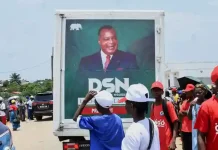








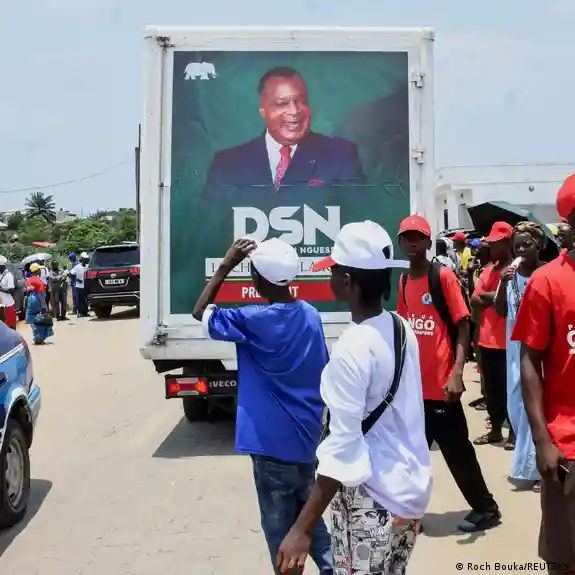
President Dennis Sassou N’Guesso, 82, seems set to win a fifth term in a row in Sunday’s election in the Republic of Congo. Sassou N’Guesso is already one of Africa’s longest-serving leaders.
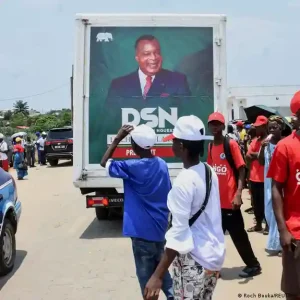
Voters in the Republic of Congo are choosing a new leader on Sunday, with the incumbent, President Dennis Sassou N’Guesso, expected to win again after more than four decades in power in the oil-rich central African country.
Three million people from a population of 5.7 million are registered to vote in the election, which pits Sassou N’Guesso against six other candidates, none of whom is seen as having a realistic chance of winning the top job.
Two other major parties are boycotting the elections over allegations of unfair electoral practices.
Voting stations opened at 7:00 a.m. local time and are to close at 6:00 p.m. (1700 GMT). Observers say voter turnout could reach a record low.
What is the situation in the Republic of Congo?
More than half the population of the Republic of Congo, sometimes called Congo-Brazzaville, lives below the poverty line, despite the country possessing one of the largest oil reserves in sub-Saharan Africa.
Hydrocarbons accounts for more than three-quarters of export earnings.
Critics of the government say the country’s growth has been hindered by the fact that huge amounts of revenue generated by oil has found its way into the pockets of senior officials.
The Republic of Congo also has high international debt that currently stands at 94.5% of GDP, according to the World Bank, while struggling with spiralling unemployment among its young people.
The government has already been targeted by several criminal complaints and investigations, notably in France, the former colonial power with which the country still has close relations, while also maintaining close ties with Russia.
Who is Sassou N’Guesso?
Sassou N’Guesso first led the Republic of Congo under a one-party system from 1979 before losing the first multi-party elections — which he himself organized — in 1992.
He then led a militia that overthrew the winner in a four-month civil war in 1997 and returned to power.
He was re-elected in 2002, 2009, 2016 and 2021 in votes the opposition said were undemocratic and lacking in transparency.
A constitutional referendum in 2015 removed presidential age and term limits, allowing him to run again.
Sassou N’Guesso has been accused by rights groups of persecuting opposition activists.
Currently, two opposition figures who took part in the 2016 election campaign, Jean-Marie Michel Mokoko and Andre Okombi Salissa, are in jail with 20-year sentences for allegedly posing a “threat to internal security.”
Sassou N’Guesso is now already the third-longest serving African president, behind Cameroon’s Paul Biya and Equatorial Guinea’s Teodoro Obiang Nguema Mbasogo.
Edited by: Saim Dušan Inayatullah
DW News

