



















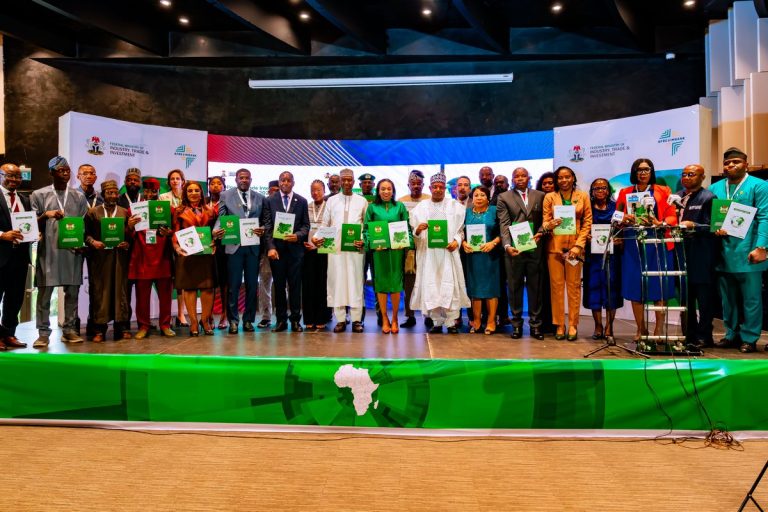
Nigeria has restated its determination to seize the vast opportunities within the African Continental Free Trade Area (AfCFTA), as the Minister of Industry, Trade and Investment, Dr Jumoke Oduwole, declared that the country must fully unlock its share of the continent’s $3.4 trillion market.
Speaking at the opening of the inaugural AfCFTA Public–Private–Press (P3) Summit in Abuja on Monday, the minister said the moment demands coordinated national action and a united push across government, business, and the media to advance President Bola Tinubu’s economic agenda.
According to her, the global economy has entered the year under heavy pressure from shifting geopolitical and trade dynamics, but Nigeria has nonetheless recorded rising industrial capacity, stronger diversification trends and expanding continental prospects. She said the AfCFTA remains central to sustaining this momentum, describing it as the largest free trade area in the world by number of participating countries, with a combined GDP of $3.4 trillion and a young, growing population of 1.4 billion people. “Africa retains more value when she trades with herself,” she stated, adding that Nigeria is well-positioned to lead that process.
Dr Oduwole reminded the audience that Nigeria has long driven regional integration efforts, citing major instruments conceived in the country, including the Lagos Plan of Action and the Abuja Treaty. She noted that the AfCFTA negotiations were concluded in Abuja in 2017, with Nigeria ratifying the agreement in 2020. The minister emphasised that 2025 has already shown decisive action, recalling that in January Nigeria hosted the AfCFTA Secretary-General to signal readiness, while in February the President was named Co-Champion of the AfCFTA Protocol on Digital Trade at the African Union Summit.
She highlighted further progress, including the March inauguration of the AfCFTA Central Coordination Committee to ensure effective implementation and the April gazetting of Nigeria’s Provisional Schedule of Tariff Concessions, which now permits preferential tariffs for goods traded across African countries and guarantees similar treatment for Nigerian products.
Dr. Oduwole also pointed to Nigeria’s commitment to easing export logistics, noting the creation of a dedicated Exports Air Cargo Corridor to East and Southern Africa in partnership with Uganda Airlines, the Nigeria Customs Service, and UNDP. She said the initiative has slashed cargo rates by 50 to 75 per cent, helping Nigerian products reach African markets faster and cheaper. She added that Nigeria will host the second AfCFTA Digital Trade Forum in Lagos in 2026 and has also secured the hosting rights for the Intra-African Trade Fair 2027.
The minister disclosed that Nigeria submitted its Schedule of Specific Commitments for Trade in Services in October, enabling Nigerian service providers to expand across the continent on preferential terms from 2026. She described this as critical, noting that while Nigeria recorded $16.49 billion in trade in services in 2024, only 20 per cent was exported, and services still contribute less than 10 per cent of national exports. She also confirmed that the Federal Executive Council has approved the ratification of the AfCFTA Protocol on Digital Trade.
Dr. Oduwole urged the country to urgently diversify its export basket into higher-value processed and industrial products and to dramatically scale up services exports. She told the summit that Nigeria’s success depends on strong collaboration among government, the private sector and the press, saying the shared goal is to build a “One African Market that is made, powered and led by Nigeria.” Also speaking at the event, the President of Afreximbank, Dr. George Elombi, reaffirmed the bank’s commitment to driving Africa’s industrialisation agenda, insisting that value addition, stronger regional production lines and accessible financing will determine the long-term success of the African Continental Free Trade Area (AfCFTA).
Elombi said Afreximbank remains fully aligned with the vision of a unified African market and has been working for a decade to ensure the continent is prepared to take full advantage of the agreement.
He revealed that Afreximbank has mobilised $40 billion to support the AfCFTA, with the bulk of the funds dedicated to helping producers scale up, modernise and expand. According to him, the bank’s goal is simple: ensure African manufacturers, farmers, SMEs and exporters have the finance required to produce competitively and move goods across borders without hurdles.
Elombi praised the growing network of air cargo corridors connecting African markets, describing them as a breakthrough for exporters seeking faster and cheaper logistics options. He noted that 49 countries have ratified the AfCFTA agreement, providing a stronger foundation for expanding intra-African trade and reducing dependence on overseas markets. “Afreximbank must ensure AfCFTA succeeds,” he said, adding that the media must also play an active role by sustaining accurate, development-driven reporting that strengthens public confidence in the project.
He highlighted several Afreximbank initiatives designed to boost continental trade, including the Intra-African Trade Champions programme, which provides facilities to large exporters moving goods within and outside Africa. He also disclosed that investors in industrial zones are being targeted for tailored support, and that the bank has earmarked an additional $10 billion to fund private-sector players in sectors such as pharmaceuticals and manufacturing.
Afreximbank, he said, is also working with the AfCFTA Secretariat to establish export trading companies to help SMEs, women and smallholder farmers who face structural barriers when trying to enter foreign markets. Another major intervention includes plans for dedicated intra-African maritime routes to allow African countries trade efficiently via sea, as well as a continent-wide transit guarantee scheme built on a new digital platform already being tested with COMESA and the East African Community.
Elombi stressed that Africa’s low share of intra-continental trade is directly linked to infrastructure gaps, red tape, weak transport systems and poor access to market intelligence. He said Afreximbank’s current programmes are targeted precisely at removing these obstacles, enabling African products to move “from factory floors to regional markets with speed and certainty.”
The sun

