
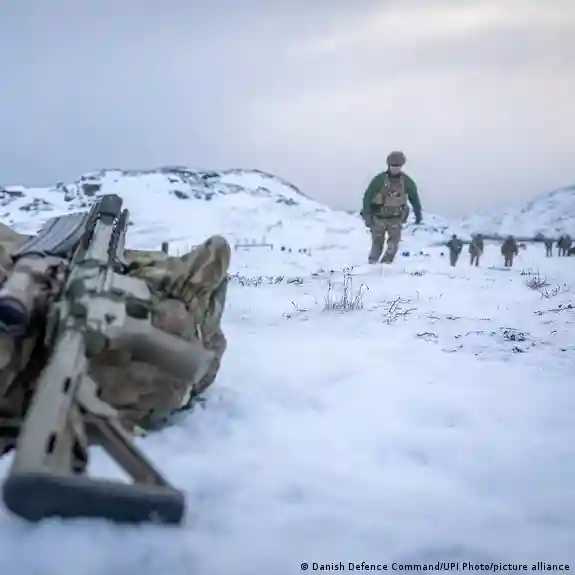
Through the “Arctic Sentry” mission, NATO is bolstering its military presence in the Arctic in an effort to de-escalate the conflict over Greenland.
The new mission “will leverage NATO’s strength to protect our territory and ensure the Arctic and High North remains secure,” according to a statement from US General Alexus Grynkewich, NATO’s Supreme Allied Commander Europe.
“Arctic Sentry underscores the alliance’s commitment to safeguard its members and maintain stability in one of the world’s most strategically significant and environmentally challenging areas,” the statement said.
According to NATO, the mission would initially oversee ongoing operations by alliance members in the region, such as upcoming exercises by Norway and Denmark.
It was unclear whether the “Arctic Sentry” would entail sending additional military capabilities to the region.
NATO in crisis over Greenland
Last month, Trump renewed his push to seize control of Greenland, a semi-autonomous territory that is part of the Danish kingdom, citing alleged threats by Russia and China in the Arctic.
His comments plunged the transatlantic alliance into its deepest crisis in years, with some allies suggesting increasing NATO’s presence in Greenland to defuse the dispute over the territory.
After a January meeting with NATO Secretary General Mark Rutte, the US president backed off his vow and announced that a framework for a future agreement on Greenland and the entire Arctic region had been drafted.
The agreement aims to ensure security in the Arctic through joint actions by the seven Arctic allies: the United States, Canada, Denmark, Norway, Sweden, Finland, and Iceland.
Germany’s Defense Ministry Spokesman on Arctic Sentry Mitko Müller told DW that Germany would be involved in NATO’s Arctic activities, yet said details of the involvement would be available later.
According to information obtained by the German dpa news agency, the German Armed Forces, or Bundeswehr, plan to participate in “Arctic Sentry” with Eurofighter and A400M transport aircraft.
Edited by: Rana Taha
DW News

