
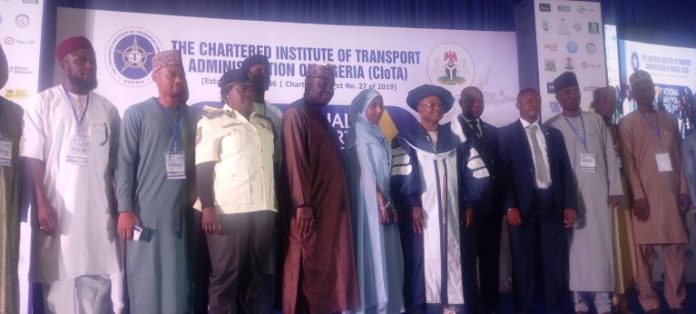
The Minister of Transportation, Said Alkali, has described the newly assented land transport policy as a milestone framework that will harmonise standards, improve coordination, and foster private sector achievements across the sector.
The Minister made the remark on Tuesday in Abuja, while presenting a keynote address at the ongoing National Transportation Conference (NTC) organised by the Chartered Institution of Transportation Administration of Nigeria (CIOTA).
Alkali, who highlighted the 2025 theme, “Repositioning Nigeria’s Transport Infrastructure and Governance Models for Global Competitiveness,” said the policy is penned in that theme, which could not have been more apt.
He said the policy resonates strongly with the Federal Government’s Renewed Hope Agenda, which seeks to transform Nigeria into a fully integrated, productive, and competitive economy with transportation as a primary enabler.
“Let me begin by expressing profound appreciation to His Excellency, President Bola Ahmed Tinubu, GCFR, whose visionary leadership continues to provide the enabling environment for sustainable growth in the transport and logistics ecosystem. Under his administration, critical reforms and investments have accelerated across all transport modes, and the Federal Executive Council has approved the National Land Transport Policy to harmonise standards, improve coordination, and foster private-sector participation.
“It is a milestone framework that will harmonise standards, improve coordination, and foster private-sector participation.
Strategic Achievements Across the Sector
The minister further highlighted the need for the deployment of Public-Private Partnership (PPP) driven e-ticketing platforms on the Lagos-Ibadan, Abuja-Kaduna, and Warri-Itakpe-Ajaokuta lines has greatly improved transparency, accountability, and user experience.
“To sustain public confidence, I have directed the Managing Director of the Nigerian Railway Corporation to set up a special committee to investigate challenges in ticket purchase processes, particularly on the Abuja-Kaduna route. A new route manager has been deployed pending the outcome of that review to ensure service integrity and efficiency.
On the policy and institutional reforms, he emphasised that
The unbundling of the Nigerian Railway Corporation is underway to improve operational efficiency and service delivery.
The Federal University of Transportation, Daura, is now making steady progress as Nigeria’s premier transport university, driving research, innovation, and capacity development across all transport modes.
The first-ever National Land Transport Policy has been validated by stakeholders and is set for full Federal Executive Council approval. I am aware of CIOTA’s advocacy efforts and inputs toward achieving this national goal, which has eluded the nation for decades. Oct
Speaking in a welcome address, the President and Chairman of the Governing Board of the Chartered Institute of Transport and Administration (CIOTA), Prince Segun Obayendo, stated that this year’s National Transport Conference will be its most impactful yet for our great institute, CIOTA.
“As I stand before you today, I’m reminded of a journey we began together two and a half years ago. We faced a Nigeria where transport was often seen as an afterthought, fragmented, undervalued, and struggling to find its voice in national discourse.
“Today, I’m proud to report that the narrative has changed dramatically. In 2023, we confronted “Emerging National Challenges and Prospects in Transportation Modes.” We didn’t just talk, we acted. We grew our membership by over 100% across all categories, established several new state chapters, and most importantly, we found our voice as the authoritative voice of transport in Nigeria.
In 2024, we tackled “Sustainable Transportation in a Disruptive Era,” and again, we delivered. We didn’t just adapt to disruption, we led it. Through our advocacy, Nigeria finally adopted the Transport Cadre, a milestone that took decades to achieve but became a reality under our collective leadership. Let me appreciate Mr Abdulahi Adewale from Osun State, who single-handedly fought in Osun State to ensure that the Transport Cadre becomes Law and is being practiced. We fought for the National Land Transport Policy and today it is live. Also, the creation of the Marine and Blue Economy simultaneously birthed its Policy and Development Plan. However, at the level of the Sub-National, only Kaduna and Lagos states have a Transport Policy, a gap we must urgently address.
Obayendo said that while the country celebrates rail renaissance under the current administration, while it acknowledges the progress in road infrastructure, and while the citizens see glimpses of aviation sector recovery, it should be reminded that global competitiveness demands more than incremental improvements. “Our infrastructure statistics tell a compelling story of both progress and potential. With 22 airports serving our vast nation, numerous rail stations connecting our major cities, and expanding port facilities, we have the foundation. But we must ask ourselves: are we maximising their potential for global competitiveness?
The Lagos-Ibadan rail line is operational, but Singapore moves 5 million passengers daily on its MRT. Our airports are improving, but Dubai International handles 80 million passengers annually with clockwork precision. Our ports are being modernised, but Rotterdam processes containers in hours, not days. This is not to diminish our achievements, but to calibrate our ambitions.
“The theme we’ve chosen for 2025 is both timely and urgent. “Repositioning Nigeria’s Transport Infrastructure and Governance Models for Global Competitiveness” acknowledges that we’re not just building transport systems, we’re building the arteries of a modern economy.
Global competitiveness in transport means seamless multimodal integration. It means a passenger can travel from Kano to Lagos by rail, connect to an international flight, with their cargo moving simultaneously through efficient logistics chains. It means governance models that prioritise efficiency over bureaucracy, innovation over tradition.
He said that the conference, which goes through the next three days, must address four critical imperatives: First, Infrastructure Optimisation, not just building more, but building smarter with the aid of technology.
The sun

