














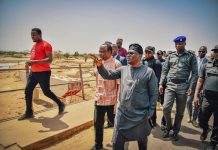


Minister of Transportation Saidu Alkali and the Nigerian Railway Corporation (NRC) Managing Director, Kayode Opeifa, have denied claims that sabotage was behind last week’s Abuja–Kaduna train derailment.
Both officials assured the public that rail travel remains safe despite ongoing investigations.
Speaking with reporters at the State House over the weekend, Alkali confirmed that the inquiry into the accident is still in progress but stressed that early findings suggest the cause was an operational error rather than deliberate sabotage.
“We have fixed the point machine from here up to Kaduna, and since then, there has been no issue of derailment. For this incident, investigations are ongoing, and we don’t want to preempt the committee until it submits its report,” the minister stated.
For context, a point machine (or switch motor) is a device that allows trains to shift tracks by moving the blades of a railway turnout securely.
Alkali acknowledged that vandalism remains a persistent problem on Nigeria’s railways despite efforts that have led to arrests and prosecutions. He revealed that four of the ten coaches that overturned in the accident have been removed using specialised rail cranes.
He also disclosed that the federal government, via the Office of the National Security Adviser, is devising a strategy to better protect railway infrastructure across the country.
Additionally, the minister mentioned ongoing procurement exercises aimed at expanding rail links from Warri through Ajaokuta to Abuja.
Data from the National Bureau of Statistics (NBS) shows that Nigeria experienced 188 train derailments between 2020 and 2025, with the majority occurring from 2020 to 2022: 57 in 2020, 61 in 2021, and 65 in 2022. Derailments have remained the most common form of rail accidents nationally.
The NRC Managing Director, Opeifa, issued an unreserved apology to journalists who faced challenges while covering the derailment, particularly the Nigerian Television Authority (NTA) reporter who was denied access to the accident site. His apology followed a protest letter from the Nigeria Association of Women Journalists (NAWOJ), which criticised the treatment of its former national chairperson, Ladi Bala.
Bala was reportedly harassed and verbally assaulted by Opeifa on Wednesday, August 27, while covering the aftermath of the Abuja–Kaduna train derailment.
Eyewitnesses said Opeifa disrupted her live reporting, hurled insults at her, including “stupid,” “foolish woman”, and “useless”, and ordered security operatives to forcibly remove her from the scene.
The sun

