










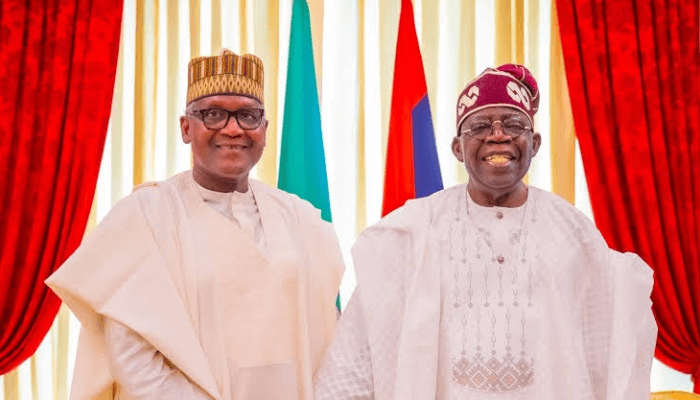
In a landmark announcement following a meeting with President Bola Tinubu in Abuja on Friday, Africa’s richest businessman Aliko Dangote declared an end to Nigeria’s notorious fuel queues, tracing the historic struggle back to 1972. Speaking confidently about Nigeria’s new role as a major fuel supplier, Dangote pledged that fuel scarcity is now a problem of the past, thanks to his company’s massive refining capacity and strategic plans.
“If you look at it, in Nigeria we have been having fuel queues since 1972 and you know, we have actually removed those queues,” Dangote told State House Correspondents. “For the first time, we’re actually suppliers to Europe and the US.
Today, we have written to Nigerian Midstream and Downstream Petroleum Regulatory Authority (NMDPRA), the midstream regulator, and confirmed we can supply 50 million liters every day. I can tell you right now, even while servicing the refineries, there are no queues. So the question of getting queues is history. It will never, ever happen by the grace of God, no more.”
The industrialist went on to reveal that Nigeria will not only meet its own fuel demand but will become an export hub, supplying neighbouring African countries and beyond by February with an extra 15 to 20 million liters daily above national consumption.
“Our neighbours will have no queues at all because they can buy from us officially,” Dangote said. “We are going to serve our domestic industries, including plastic manufacturers, who previously spent $350 to $400 million on imports. We will take that out.”
Dangote’s ambitious vision extends beyond fuel. He disclosed plans to expand his refinery to become the largest globally by 2028, surpassing India’s Reliance Industries, with a capacity of 1.4 million barrels per day compared to Reliance’s 1.25 million.
“We have already launched this project. We have signed and will start piling for the refinery by January, and it will be delivered on time,” he asserted.
On fertilizer production, Dangote outlined a bold continental strategy. His company aims to produce 12 million tons of urea fertilizer, positioning Nigeria as Africa’s agricultural supplier leader—outproducing giants like Russia and Qatar.
“What we are going to do by 2028 we are going to take this refinery to the largest refinery in the world we’re going to beat reliance. Reliance is 1.25 million barrels per day, we will be at 1.4 million barrels per day.
We have already launched that we have signed, and we’re going to start piling for the refinery by January, before January ending, and it will be delivered on time.” On fertilizers, he aims for continental leadership: “On the fertilizer, we want to use our own fertilizer company here in Nigeria to supply the entire African continent. We’re going to have urea production of about 12 million tons. 12 million tons will put us at the largest, you know, company producing urea, bigger than Russia and bigger than Qatar,” he emphasised.
Addressing recent price fluctuations in petroleum products, Dangote explained that prices are declining due to competition with imports and efforts to curb smuggling, which he described as a significant challenge given the large price disparity between Nigeria and neighboring countries.
“Prices are going down because we have to compete with imports. Smuggling has reduced but not stopped, because the price in Nigeria is about 55% of that neighbouring countries’ prices. Smugglers make a lot of money selling at 1500 to 1600 naira while we sell at about 800 naira. But diesel and gasoline prices will continue to be reasonable.”
He reassured Nigerians that Dangote’s investments are long term, with legacy and nation-building a priority over rapid profit.
“The issue is what legacy do you want to leave? We want Nigeria to be part of delivering power and energy,” Dangote said. He also cited infrastructure bottlenecks, detailing plans to open Olokola port—the largest deep sea port in West Africa—to ease the export of Nigeria’s abundant solid minerals, currently crippled by congested ports like Apapa and Tincan Island.
Regarding the controversial “naira for crude” policy recently initiated by the Nigerian government, Dangote supported the approach as a win-win, crediting President Tinubu for its visionary aspect.
“It is me being Nigerian. I must thank His Excellency, Mr. President, for that genius idea of ‘naira for crude,’” Dangote said. While acknowledging some teething problems with crude sourcing from international oil companies, he expressed confidence that these issues will be resolved.
Dangote also addressed fears about competition generated by his supply capacity, dismissing the presence of any true domestic rivals given the sheer scale of his refinery.
“We don’t have any domestic competitor of this size. Smaller refineries doing like 5,000 per day exist but are not the same scale. Our goal is to make Nigeria the refining hub of Africa because many African countries import their products.”
He emphasised the “Nigeria First” policy advocated by President Tinubu, warning against the continual importation of goods which he described as “importing poverty and exporting jobs.”
“If we keep importing anything, we are importing poverty,” Dangote said. “We must face agriculture, industrialization, and develop manufacturing. When presidents used to drive Peugeot 504, and everyone aspired to Rolls Royce today, they should invest in industries that create jobs instead of private luxuries.”
On Nigeria’s population boom—8.7 million babies born annually—Dangote highlighted the urgency of industrial growth to provide power, infrastructure, and fuel needed for development.
Dangote also called for government facilitation through enabling policies, stressing the corporate duty of paying taxes to support public services.
“If I pay tax, your children can go to school, go to hospital. We must stop calling for foreign investors. The real investors are domestic investors attracted by good policies and rule of law.”
He reflected on Nigeria’s painful textile industry collapse due to smuggling, a cautionary tale fueling his commitment to industrialization.
“Previously, 7,000 textile workers were sacked overnight because smuggling killed the industry. Nobody else will industrialize Nigeria except us.”
On his meeting with President Tinubu, Dangote described a cordial, productive exchange focused on economic and environmental issues.
“We just had a normal catch-up. Once in a while, I sit down with His Excellency. It was very nice, very fruitful.”
The sun

