

The charge of aggravated murder means the suspected shooter could face the death penalty if convicted of killing right-wing activist Charlie Kirk at an event last week.

The suspect in the killing of right-wing activist Charlie Kirk was charged with seven counts, including aggravated murder, prosecutors said on Tuesday.
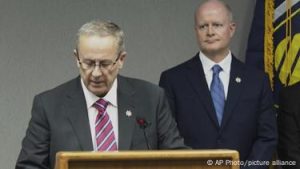
Utah County District Attorney Jeffrey Gray told a press conference that suspect Tyler R.* also faces charges, including obstruction of justice for disposing of evidence and witness tampering for ordering his roommate to delete texts and committing a violent crime when children are present.
Gray said he had decided to seek the death penalty “independently, based solely on the available evidence and circumstances and nature of the crime.”
“I was not pressured to make a decision” on whether to choose the death penalty, Gray told reporters at a press conference.
The suspect later briefly appeared in court via video feed from jail in his first public appearance since the shooting. Gray told Tyler R. that he will “remain in custody, without bail.”
His next hearing will be on September 29.
The investigation into Kirk’s shooting so far
Kirk was shot and killed on September 10 as he spoke with students during an event at Utah Valley University. The suspect was arrested on Thursday near the town of St. George, the southern Utah community where he grew up.
Prosecutors allege Tyler R. shot Kirk in the neck with a bolt-action rifle from the roof of a nearby campus building.
Gray said the suspect’s DNA was found on the trigger of the rifle used to kill Kirk. He added the suspect allegedly asked his roommate to hide evidence, and sent text messages to the roommate saying he killed Kirk because he “had enough of his hatred.”
In the text exchange released by prosecutors, the suspect seems to describe in detail his actions after the shooting, including leaving the murder weapon behind.
A judge will determine at trial whether the communication with the roommate amounts to a confession, Gray said, insisting that his office will ensure a fair trial.
Alluding to the massive amount of public interest in the murder, Gray said the case will not be tried “in the court of public opinion.”
Any information on the proceedings would be shared intermittently to ensure due process is not compromised, he added.
Tyler R. also left a note saying he planned to kill Kirk, according to court documents.
Tensions in US after Kirk’s killing
FBI Director Kash Patel, who has been heavily criticized for his actions in the immediate aftermath of the assassination, faced a grilling from a Senate panel on Tuesday.
Patel has been criticized for quickly announcing the arrest of a separate suspect, only to say that person had been released hours later.
The FBI Director said an investigation into Kirk’s killing was ongoing, although the Utah district attorney did not indicate there was any evidence the suspect had conspired with others.
“We are investigating Charlie’s assassination fully and completely and running out every lead related to any allegation of broader violence,” Patel said.
In the days since Kirk’s assassination, many have raised alarm about the rise in political violence in the US.
Despite calls for greater civility, some critics of Kirk’s controversial remarks on gender, race, and politics voiced their disapproval of Kirk on social media after his murder.
In response, many Republicans spearheaded efforts to punish those critics, resulting in both public and private employees being fired from their jobs or facing other consequences at work.
On Monday, US Vice President JD Vance appeared on Kirk’s podcast, and said: “When you see someone celebrating Charlie’s murder, call them out.”
Vance also vowed to target “liberal” networks the Trump administration has claimed, without providing evidence, inspired the shooter.
Vance said on Monday that an “incredibly destructive movement of left-wing extremism” had helped lead to Kirk’s killing.
Edited by: Wesley Rahn
DW News

