
















The two countries said the agreement aimed to safeguard Europe’s automotive industry, encouraging development and research. Automakers in Europe have so far struggled to compete with Chinese electric car companies.
The plan aims to cut CO2 emissions and support the development and construction of electric cars in Europe, the statement added.
“Our shared ambition is clear: to successfully transform our automotive industry while maintaining our climate ambition and ensuring that the cars of the future are produced in Europe,” the countries said.
The pact also includes incentives for investment, research and production.
Leaders welcome agreement
German Chancellor Friedrich Merz welcomed the agreement, describing it as a “good day for car drivers and for jobs in Germany, France and Europe.”
“This is an investment signal to industry,” he posted on his X account.
French President Emmanuel Macron, for his part, said the agreement shows a “clear ambition to successfully transform” the European automotive industry while upholding Europe’s climate goals.
“We hope that this Franco-German dynamic can swiftly lead to an agreement with our partners, for our jobs and our industry,” Macron wrote.
According to a Handelsblatt report, the two leaders have also agreed in principle to require automakers to cut exhaust emissions from new cars by 90% from 2035, without having to offset the remaining 10%, revising the bloc’s proposed target.
The pact will need backing from other EU states and the European Parliament to become law.
Volkswagen praises German-French deal
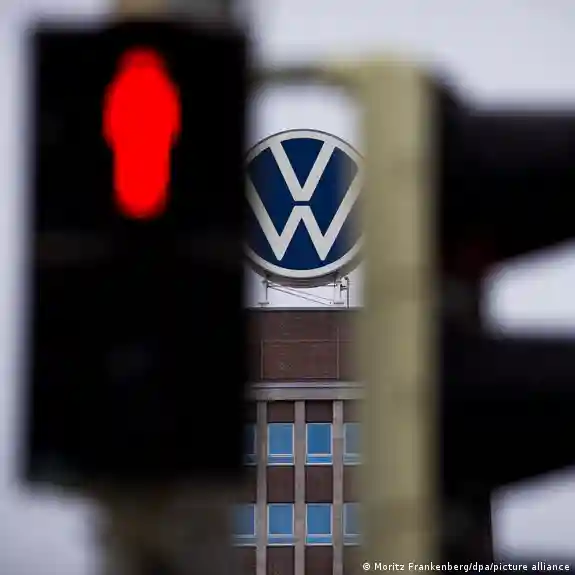
Germany’s largest carmaker, Volkswagen, welcomed the deal between France and Germany to soften EU car emissions rules. In a statement, it called the deal a “strong signal” that shows responsibility to the automotive industry.
“The joint position of Germany and France… sends a strong signal to Europe and demonstrates its ability to take action,” a Volkswagen spokesperson said.
While still assessing the full details, Volkswagen saw “meaningful flexibilities” that will “help the automotive industry make its contribution to climate protection without jeopardizing its competitiveness,” according to the statement.
Hildegard Müller, head of Germany’s VDA auto industry association, called the German-French car deal an important step. However, she added that it falls short in key areas for the industry, including jobs and climate.
Müller called for later battery localization in Europe, better rules for trucks, buses, and light vans, and a stronger emphasis on renewable fuels and green materials.
Europe’s automotive industry faces tough competition from China
European automakers have been struggling to compete with their Chinese counterparts in the electric vehicle market, resulting in cost-cutting measures.
Lower Saxony Premier Olaf Lies hailed the agreement as a “strong signal” in support of Europe’s car industry that protects jobs in the sector.
Lies is also on VW’s supervisory board, and Lower Saxony is home to Volkswagen. The company’s headquarters are located in the city of Wolfsburg.
VW is the largest car manufacturer in Europe by volume. However, the company is most exposed to overcapacity in its German plants, high fixed costs, and reliance on China.
Intense pressure from Chinese rivals, the transition to electric vehicles (EVs), and higher production costs have caused a deep structural crisis in the entire German auto industry.
Edited by: Natalie Muller and Wesley Dockery
DW News

