
















The new law means Mandarin will become the official languages for purposes such as education and public affairs. According to human rights groups, the move could contribute to the marginaliation of minorities.
China’s National People’s Congress approved legislation promoting what it calls the “ethnic unity” law, which human rights groups say could further marginalize minority groups.
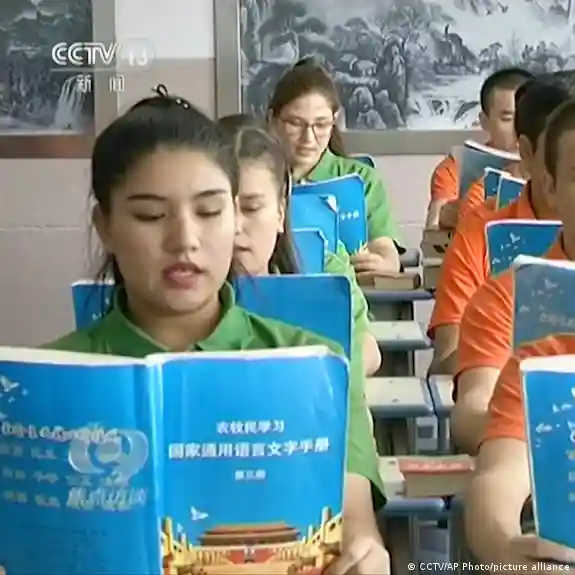
The law formalizes policies in order to promote Mandarin as the “national common language” for official purposes such as education and public affairs.
As part of the law, educational institutions will now be obliged to teach in Mandarin, with teenagers required to have a “basic grasp” of Mandarin when finishing their compulsory education.
It also states that the law can be applied outside China’s borders, meaning people outside China who “engage in activities that undermine ethnic unity” or incite “ethnic separatism” can be held legally liable.
Allegations of forced assimilation
The Chinese government has for decades faced allegations of trying to force assimilation of minorities into the Han majority.
China acknowledges 55 official ethnic minorities within its territory that speak hundreds of languages and dialects.
While no minority languages are specifically mentioned in the law, it is likely to affect Uyghur, Mongolian and Tibetan speakers.
At the center of the law is the criminalization of “violent terrorist activities, ethnic separatist activities, or religious extremist activities.”
Its stated purpose is to “strengthen cohesion” within China in response to what the law describes as unprecedented social change in Chinese society.
Certain areas with large minority populations have already seen Mandarin Chinese being turned into the mandatory language of instruction. This includes the regions of Tibet and Inner Mongolia.
Deputy Asia director at Human Rights Watch, Maya Wang, said the law is not about ensuring equality.
“The question was never so much about ensuring their participation in the economy in an equitable manner, more inclusive manner,” because the policies are being forced on Tibetans, Wang said.
“And a truly inclusive model does not preclude the ability of children to speak two languages,” Wang added.
Edited by: Kieran Burke
DW News

