














India’s Prime Minister Narendra Modi, French President Emmanuel Macron and others struck a careful balance on artificial intelligence at the summit. Meanwhile, Microsoft cofounder Bill Gates canceled his appearance.
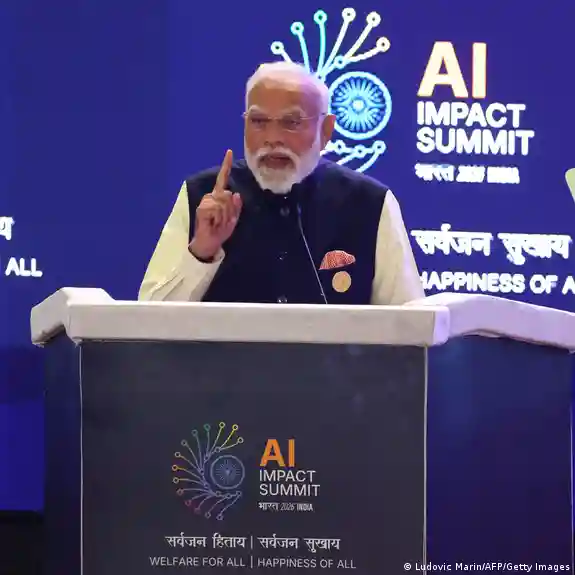
Indian Prime Minister Narendra Modi on Thursday called for responsible frameworks for the governance of artificial intelligence as well as its democratization to ensure people around the world have access to the technology.
That’s at a time when AI threatens to take over jobs and AI tools face greater scrutiny by governments all over the world.
Modi was speaking at the global AI Impact Summit event held in New Delhi, where he pitched India as a central player in the global AI ecosystem.
What did Modi say at the AI summit?
Modi told world leaders and tech executives to make sure that AI was developed in a manner so “humans don’t just become a data point or remain raw material for AI.”
“We must democratize AI,” Modi said.
Modi unveiled India’s MANAV framework for AI governance. The acronym stands for: moral and ethical systems, accountable governance and robust oversight, national sovereignty, accessible and inclusive, valid and legitimate.
Organizers said the summit was the first summit of its kind to be held in the Global South to discuss the technology developed and dominated by wealthy companies based in rich countries.
The summit, previously held in France, the UK and South Korea, has evolved from its modest beginnings as a meeting focused on safe use of AI into an all-purpose jamboree trade fair where safety is just one aspect.
India has experience in building large-scale public infrastructure. Officials said the experience offers a model for deploying AI at scale while keeping costs low.
Who was present at the AI summit?
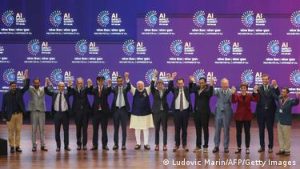
French President Emmanuel Macron, Spain’s Prime Minister Pedro Sanchez and Brazil’s President Luiz Inacio Lula da Silva were among some of the leaders in attendance. Top tech executives like OpenAI’s Sam Altman and Google’s Sundar Pichai were also present.
Bill Gates cancels appearance at AI summit
Microsoft cofounder Bill Gates pulled out of the summit hours before his scheduled keynote address.
His foundation said in a statement that Gates withdrew “to ensure the focus remains on the AI Summit’s key priorities.”
Gates’s withdrawal comes as he faces fresh scrutiny over his ties to the late financier and convicted sex offender Jeffrey Epstein.
Nvidia’s CEO Jensen Huang also canceled his appearance. The company is the world leader in chips crucial for artificial intelligence.
The cancellations dealt a blow to the gathering that also saw controversies of many kinds. Indian university Galgotias, for example, was asked to vacate its stall after a staff member presented a commercially available robotic dog made in China as its own creation, sparking a public uproar.
Macron says he’s determined to shape a digital future with India
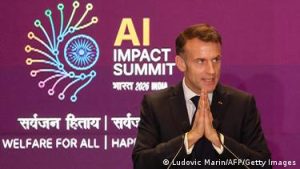
French President Emmanuel Macron spoke before Modi.
“We are determined to continue to shape the rules of the game… with our allies such as India,” Macron said. “Europe is not blindly focused on regulation. Europe is a space for innovation and investment, but it is a safe space,” he said.
The European Union’s data privacy watchdog has launched an investigation into Elon Musk’s X over concerns about sexualized images generated by the site’s AI chatbot, Grok.
“One of our G7 priorities will be, as well, children’s protection against AI and digital abuse,” Macron said, adding that children should not be exposed online to “what is illegal in the real world.”
Growing number of countries seeking to enact social media laws
France, along with a number of Western countries, are seeking to enact legislation to safeguard children from digital harms. India’s government said the country was considering restrictions for children too.
“Done right, AI can accelerate breakthroughs in medicine, expand learning opportunities, strengthen food security, bolster climate action and disaster preparedness and improve access to vital public services,” said UN chief Antonio Guterres at the summit.
Done wrong, it could “fuel harm,” he said.
Edited by: Roshni Majumdar
DW News