









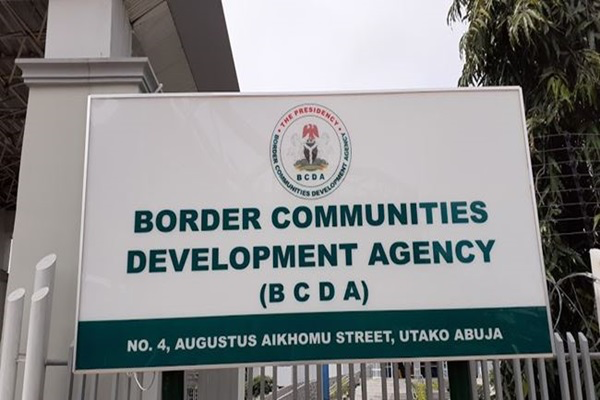
A critical review of the Border Communities Development Agency’s (BCDA) 2026 budget proposal has raised fresh concerns about transparency deficit and questionable prioritisation, as most of the commission’s capital projects appear to fall outside its statutory responsibility to develop Nigeria’s border communities.
The BCDA, established under the Border Communities Development Agency Act of 2003 (amended in 2006), is mandated to provide basic social and economic infrastructure to communities located within 15 kilometres of Nigeria’s international land borders—or 25 kilometres in Oyo State.
By law, these border communities are spread across more than 2,000 settlements in 105 local government areas of 21 states that share boundaries with the Benin Republic, the Niger Republic, Chad and Cameroon.
However, an examination of the commission’s 2026 Appropriation Bill, currently before the National Assembly, shows that a significant portion of its proposed spending does not align with this mandate.
The BCDA plans total expenditures of N48.26 billion in 2026, with personnel costs totalling N839.6 million, including N599.5 million for salaries and wages. The bulk of the budget—N46.53 billion—is earmarked for over 475 capital projects, all tagged as “ongoing” in 2026 alone.
The unusually high number of ongoing projects, without details on their locations, start dates or level of completion, has raised concerns among budget analysts about project credibility, monitoring and value for money.
More troubling is the nature and location of many of the listed projects. For instance, the commission proposes to spend N42 million on the provision of solar lights in Kosofe and Oshodi-Isolo II Federal Constituency in Lagos State—areas firmly within metropolitan Lagos and far removed from any international border.
Similarly, N105 million has been allocated for the procurement and distribution of empowerment materials for youth and women in Ikeja Federal Constituency, also in Lagos Mainland, which does not qualify as a border community under the law establishing the agency.
Other questionable allocations include N210 million for the construction of Otun/Ibaru Road for rural farm access in Yagba East, Kogi State; N350 million for surface dressing of Kagarko–Akoti Road in Kagarko LGA of Kaduna State; N35 million for the supply of tricycles and televisions in Bomadi/Patani Federal Constituency, Delta State; and N70 million for the distribution of grinding machines in Bonny/Degema Federal Constituency, Rivers State.
None of these locations has been clearly identified as falling within the statutory border zones for which the BCDA was created.
The budget also contains several empowerment and welfare-related projects with vague or nonexistent location details, undermining transparency and accountability. These include N175 million for the empowerment of unemployed youths in transportation with motorcycles and cargo tricycles in unspecified communities; N35 million for youth and women empowerment in Plateau North Senatorial District without naming beneficiary communities; and N105 million for women and youth empowerment in an unnamed community in Kano South Senatorial District.
Further allocations include N140 million for empowerment programmes in Rivers West Senatorial District, N70 million for the supply of food grains in Gudu/Tangaza Federal Constituency, Sokoto State, and a combined N696.9 million for the provision of food items in Potiskum and Fune LGAs of Yobe State.
The commission has also budgeted N350 million for the rehabilitation and furnishing of the official palace of the District Head of Paiko, which raises questions about relevance to border development.
When this reporter contacted the agency’s media representative, Bala Ugah, for comments on the report, he did not answer calls or respond to text or WhatsApp messages.
In contrast, some budget lines do fall squarely within BCDA’s mandate, including electrification of Zaro Village and Hadejia community in Jigawa State, solar street lighting in parts of Kebbi, Kaduna and Yobe states, construction of a police station in Kwande LGA, Benue State, and health and education infrastructure in Kebbi and Kano states.
The projects align with the agency’s core objective of addressing infrastructure deficits in border areas plagued by poverty, insecurity, illiteracy and limited access to basic services.
Nigeria’s border communities remain among the country’s most underserved, often lacking roads, schools, healthcare facilities and security posts, forcing residents to rely on neighbouring countries for basic needs. It was to address these gaps that the BCDA was created as an interventionist agency.
Yet, the 2026 budget suggests a growing diversion of scarce resources away from border areas, potentially undermining the agency’s raison d’être.
As lawmakers scrutinise the proposal, fiscal accountability advocates argue that stricter oversight is needed to realign the BCDA’s spending with its legal mandate, improve project disclosure and ensure that limited public funds deliver measurable impact where they are most needed—Nigeria’s long-neglected border communities.
Leadership

