












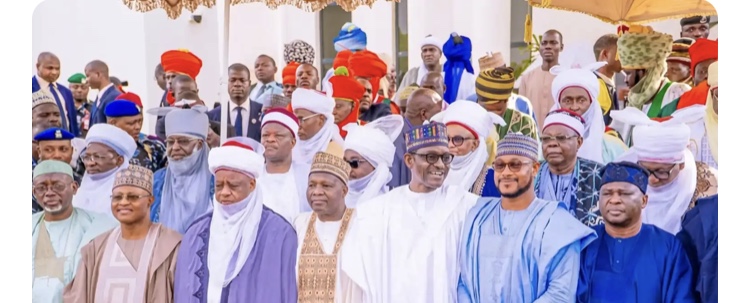
CONFRONTED by a surge in killings, abductions and illegal mining, Northern leaders have mounted an unprecedented joint response, backing state police, imposing mining suspensions and urging unity as they insist that coordinated, decisive measures are now essential to salvage the region’s security and stability.
Governors of the 19 Northern states and the region’s Traditional Rulers’ Council arrived at the decisions following an emergency joint meeting held yesterday at Sir Kashim Ibrahim House, Kaduna.
A central resolution was the immediate suspension of all mining activities in the North for six months. The governors argued that illegal mining had become a major driver of insecurity and urged President Bola Ahmed Tinubu to direct the Minister of Solid Minerals to halt all exploration activities and subject all mining licences to revalidation in consultation with state governors. They said artisanal and illegal mining operations must be contained to cut off key sources of funding and logistics for criminal groups.
The leaders also approved the creation of a Northern Regional Security Trust Fund. Under the arrangement, each of the 19 states and their local governments will contribute N1 billion monthly, deducted at source, to support regional security interventions. The framework for the fund is expected to be finalised soon.
Reiterating their long-standing position, the governors and traditional rulers declared full support for the establishment of state police. They called on federal and state lawmakers from the region to accelerate the constitutional amendments required to enable state-level policing structures.The communiqué also expressed renewed support for President Tinubu’s anti-terrorism efforts, particularly recent actions that resulted in the release of some abducted school children. The leaders praised the sacrifices of the armed forces and pledged total backing for any military operations necessary to dismantle insurgent enclaves and end terrorism and banditry.
The Forum extended condolences to the governments and people of Kebbi, Kwara, Kogi, Niger, Sokoto, Jigawa, Kano, Borno and Yobe states over recent killings, abductions and Boko Haram attacks, acknowledging the heavy toll of the ongoing violence.
Emphasising the need for unity, peer review and cooperation, the communiqué said the North could only overcome its challenges through collective determination and coordinated action. The governors and traditional rulers reaffirmed their commitment to fulfilling their constitutional responsibilities with firmness and clarity.
A follow-up joint meeting will be convened soon to review progress on the implementation of the resolutions.
ACF rejects claims it supports amnesty, payments for bandits
This came as the Arewa Consultative Forum (ACF) condemned those advocating amnesty and financial incentives for bandits involved in kidnappings and killings in the North, insisting it has never supported such proposals.
In a statement yesterday, the ACF National Publicity Secretary, Prof Tukur Muhammad-Baba, said the Forum’s attention had been drawn to a trending video on social media suggesting it endorsed amnesty and payments to bandits similar to the late President Umaru Musa Yar’Adua’s Niger Delta programme.
According to him, the insinuation appeared to stem from a recent interview granted to Arise News by Bashir Dalhatu, Wazirin Dutse and Chairman of the ACF Board of Trustees, but the clip in circulation had been “taken out of context, truncated and mischievously abstracted” to reach predetermined conclusions promoted by “clandestine and shadowy” actors.
Muhammad-Baba said the ACF typically does not respond to anonymous or shadowy groups, but the seriousness of the allegation made clarification necessary.
He explained that Dalhatu spoke largely in a personal capacity, occasionally referencing official views, and had at the start of the interview “assertively and emphatically” condemned terrorist activities in Nigeria and West Africa. Dalhatu had also called for the total annihilation of terrorists and bandits to end insecurity as soon as possible.
Muhammad-Baba added that Dalhatu stressed no one in the North or anywhere in Nigeria was happy with the security crisis or shielding those responsible for the violence.
He said Dalhatu’s reference to the Niger Delta amnesty programme was merely to suggest that both kinetic and non-kinetic approaches, where expedient, should be explored by the government, including variants of the Yar’Adua model. He noted that Dalhatu did not propose applying the programme wholesale and had said anyone advocating such solutions was expressing an opinion.
Muhammad-Baba stressed that Dalhatu made no reference to terrorists or bandits using primordial identities such as ethnicity or religion, and that suggestions otherwise were the product of “mischievous, clandestine and shadowy” individuals or groups.
He stated that the ACF had never called for amnesty for terrorists or bandits and rejected any insinuation to the contrary.Reaffirming Nigeria’s adherence to the ICC principle of complementarity, he said the country has demonstrated its capability and willingness to investigate and prosecute serious crimes committed within its jurisdiction.
Security analyst warns civilian gun ownership would worsen insecurity
Meanwhile, a retired military officer and security analyst, Siyaka Nasiru, has warned that allowing Nigerians to carry firearms for self-defence would worsen, rather than address, insecurity, describing the proposal as “an invitation to chaos”.
Nasiru issued the warning on a programme on Adamimogo 105.1 FM, Ibadan, where he analysed rising public calls for civilian gun ownership amid renewed violent attacks and mass abductions across the country. More than 490 people have been kidnapped in multiple states over the past two weeks, with communities such as Eruku in Kwara State repeatedly targeted.
He said the wave of attacks had intensified public frustration and eroded confidence in government assurances that rarely translate into improved security. But despite the growing anxiety, he insisted that arming citizens would be a dangerous mistake.
“Carrying arms is illegal and exposes citizens to even greater harm,” he said. “Self-defence begins with vigilance, sharing intelligence, reporting suspicious movements, and working closely with security agencies.”
His stance contrasts sharply with recent comments by Senator Francis Fadahunsi, who suggested that “responsible Nigerians” should be allowed to bear arms. Nasiru dismissed such proposals as emotional responses rather than sound policy ideas.
“He enjoys protections most Nigerians do not,” he said. “Firearms are expensive; if only a few can afford them, where is the balance? And after the crisis, who retrieves the weapons? That is exactly how today’s terrorism began, with politically armed groups that later became uncontrollable.”
Nasiru said Nigeria could not adopt firearm policies from other countries without considering its unique security realities.
“If we ask 250 million Nigerians to own guns, who regulates them?” he asked. “Even in the United States, where gun ownership is a constitutional right, mass killings still occur. Only yesterday, a whole family of four was wiped out.”
He urged government agencies to prioritise intelligence-led operations, better inter-agency coordination and stronger collaboration with traditional rulers and local communities. He said residents offered the most reliable intelligence but were often afraid to speak up due to fear of retaliation.
On former President Olusegun Obasanjo’s recent claim that Nigeria has enough surveillance drones to tackle insecurity, Nasiru disagreed, arguing that equipment and expertise remain inadequate.
“Our drones are insufficient, and we may not even be deploying the ones we have effectively,” he said. “Government must invest in modern tools and recruit more personnel across the military, police, civil defence, and DSS.”He also supported controlled foreign assistance in the form of training, intelligence sharing or technology transfer, provided Nigerian authorities remain in charge.
“As we seek external help for the economy, we should also be willing to seek help for security,” he added.
The guardian

