













It is unusual for world leaders to adopt a declaration at the start of the G20. Officials from G20 summit host South Africa said Washington had pressured them not to adopt a declaration in its absence.
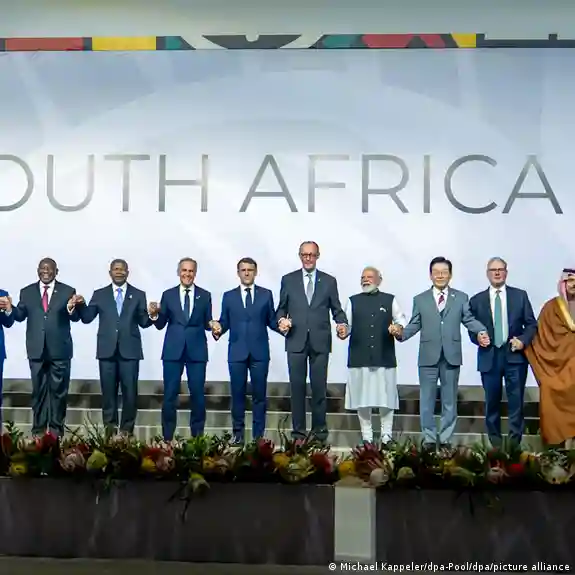
World leaders attending a Group of 20 (G20) leaders’ summit in South Africa on Saturday adopted a declaration addressing global challenges despite opposition from the United States.
The move broke with protocol as declarations are typically adopted at the end of G20 summits.
In his opening remarks, South African President Cyril Ramaphosa said: “We should not allow anything to diminish the value, the stature and the impact of the first African G20 presidency.”
This year’s summit has been overshadowed by President Donald Trump’s decision not to send a US delegation.
South African officials said Washington had put pressure on South Africa not to adopt a declaration in its absence.
While the world’s largest economy boycotted the summit, Ramaphosa argued that the G20 still played a key role in international cooperation.
“The G20 underscores the value of the relevance of multilateralism. It recognizes that the challenges that we face can only be resolved through cooperation, collaboration and partnership,” the summit’s host said.
G20 amid geopolitical crisis
Despite Ramaphosa’s optimism, French President Emmanuel Macron noted that “the G20 may be coming to the end of a cycle.”
“We are living in a moment of geopolitics in which we are struggling to resolve major crises together around this table, including with members who are not present today,” said Macron.
British Prime Minister Keir Starmer agreed with Macron’s warning.
“There’s no doubt, the road ahead is tough,” he said. “We need to find ways to play a constructive role again today in the face of the world challenges.”
Meanwhile, Chinese Premier Li Qiang, who was attending the summit instead of President Xi Jinping, said “unilateralism and protectionism are rampant” and “many people are pondering what exactly is happening to global solidarity.”
What did G20 leaders agree on in the declaration?
The 122-point declaration demanded more global action to cope with climate change.
Endorsed on the same day that the COP30 talks ended in Brazil, leaders acknowledged that “investment and climate finance” need to be scaled up “from billions to trillions globally from all sources.”
The declaration also addressed the need to reform international financial systems to help low-income countries deal with their debt.
Its language on taxing the super-rich was weaker than in the previous G20 declaration in Rio de Janeiro, where leaders agreed for the first time “to ensure that ultra-high-net-worth individuals are effectively taxed.”
Leaders also urged for a “just, comprehensive, and lasting peace” in Ukraine, Sudan, the Democratic Republic of Congo and the “Occupied Palestinian Territory” based on the UN Charter.
Although Ukraine appeared only once in the 30-page text, Western leaders at the summit scrambled on the sidelines to address a peace plan proposed by the US that would end the war in Ukraine on terms considered favorable to Russia.
Edited by: Sean Sinico
DW News

