














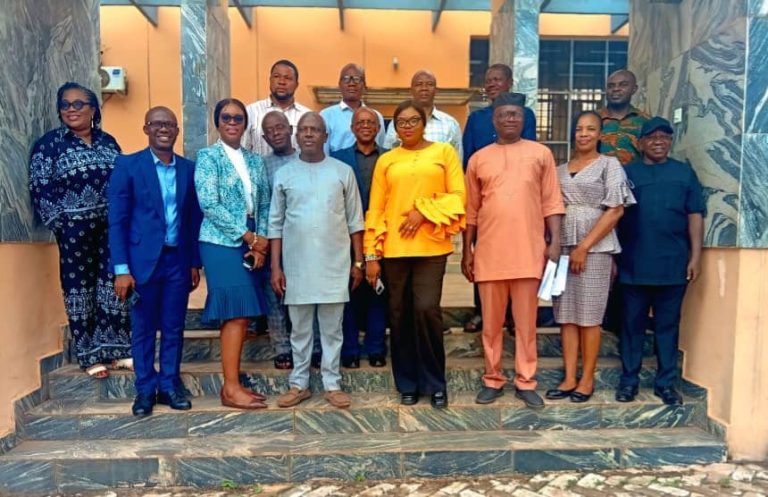
The Resource and Environmental Policy Research Centre, Environment for Development (REPRC-EfD) Nigeria, University of Nigeria, Nsukka (UNN) yesterday held a one-day training workshop for journalists on effective communication of environmental research findings to the public.
The training, tagged “Role of the Media in Promoting Environmental Research”
aimed to equip journalists with the tools to report and communicate effectively to the public and policymakers on environmental research that would help to raise awareness, foster civic engagement, and hold institutions accountable.
Declaring the training workshop open, Dr Nnaemeka Chukwuone, Director, REPRC-EfD UNN, said the centre was established to advance interdisciplinary research, capacity building and policy advocacy on a sustainable environment.
He disclosed that the centre has four mandates which are; Institutional for leadership development, Environmental natural resource research, Capacity building, and Policy advocacy.
The Director, represented by Prof Innocent Ifelunini, Deputy Director of the centre noted that they recognise the role of journalists in society and consider them as vital partners that will help in communicating research findings and government policies to organisations and the general public.
“We consider journalists as vital partners, because even when we make giant strides in research, it will not have much positive impact on the public without involving the media that will disseminate the information.
“The media is very imperative in escalating the evidence-based result of our research findings, that’s why we consider journalists as our active and formidable partners,” he said.
The director said further that the centre has been involved in so many research activities that have produced impactful results nationally and internationally.
According to him, this is because the centre has always involved stakeholders and policy makers right from the beginning to achieve formidable results.
Prof Luke Anorue, REPRC-EFD Admin Officer, while presenting a paper titled: “Interpreting Environmental Research for Public Communication,” emphasised the importance of effective communication to the target audience.
He said that environmental research findings must be interpreted and communicated to the policy makers and public in simple terms and language that each target audience will understand without difficulty.
“Environmental research drives global change, communication converts knowledge to action, while the public acts on what they understand, as such, journalists should help and communicate research findings effectively to the target audience,” he said.
While speaking on the topic: “Environmental Challenges in Nigeria and the Role of REPRC-EFD Nigeria in Providing Evidence-based Solutions,” Dr Chzoba Oranu, a Research Fellow at the centre, alleged poor media reports on environmental degradation in the country.
“Journalists are like public gatekeepers, researchers are looking up to them to communicate effectively findings on the management of environmental challenges to the general public for sustainable development.
“As a journalist, don’t wait until disaster happens before reporting. You are expected to intermittently do reports that will educate and communicate research findings, government policies on environmental management to the general public,” she said.
Mr Inya Egwu, Communication Officer, REPRC-EfD Nigeria and the Acting Public Relations Officer, UNN in his presentation titled; “Data Journalism and the Use of Infographics in Environmental Reporting,” charged journalists to use data analysis to uncover and tell stories.
Egwu explained that data Journalism involves gathering and analysing large datasets to find hidden trends, explain complex issues, and present findings through visualisations like infographics, charts, tables and interactive maps.
“This approach relies on empirical evidence to produce stories that are often more objective, attract attention and can reveal insights that can not be disputed,” he said.
Journalists from different media houses across the country who participated in the workshop commended the centre for the training and for enhancing their understanding of the promotion of environmental research findings for sustainable development.
The sun

